
A Comprehensive Guide to Comparing EPDM Roofing Options in Wesley Chapel and Tampa Bay
What EPDM Roofing Is for Pasco and Hillsborough County Properties
EPDM roofing is a durable synthetic-rubber membrane used to waterproof low-slope and flat roofs. For property owners in Wesley Chapel, Lutz, Land O Lakes, and Oldsmar comparing membrane options, Thunder Bay Roofing’s local low-slope roofing guidance can help clarify whether EPDM fits the roof’s drainage, exposure, and long-term maintenance needs.
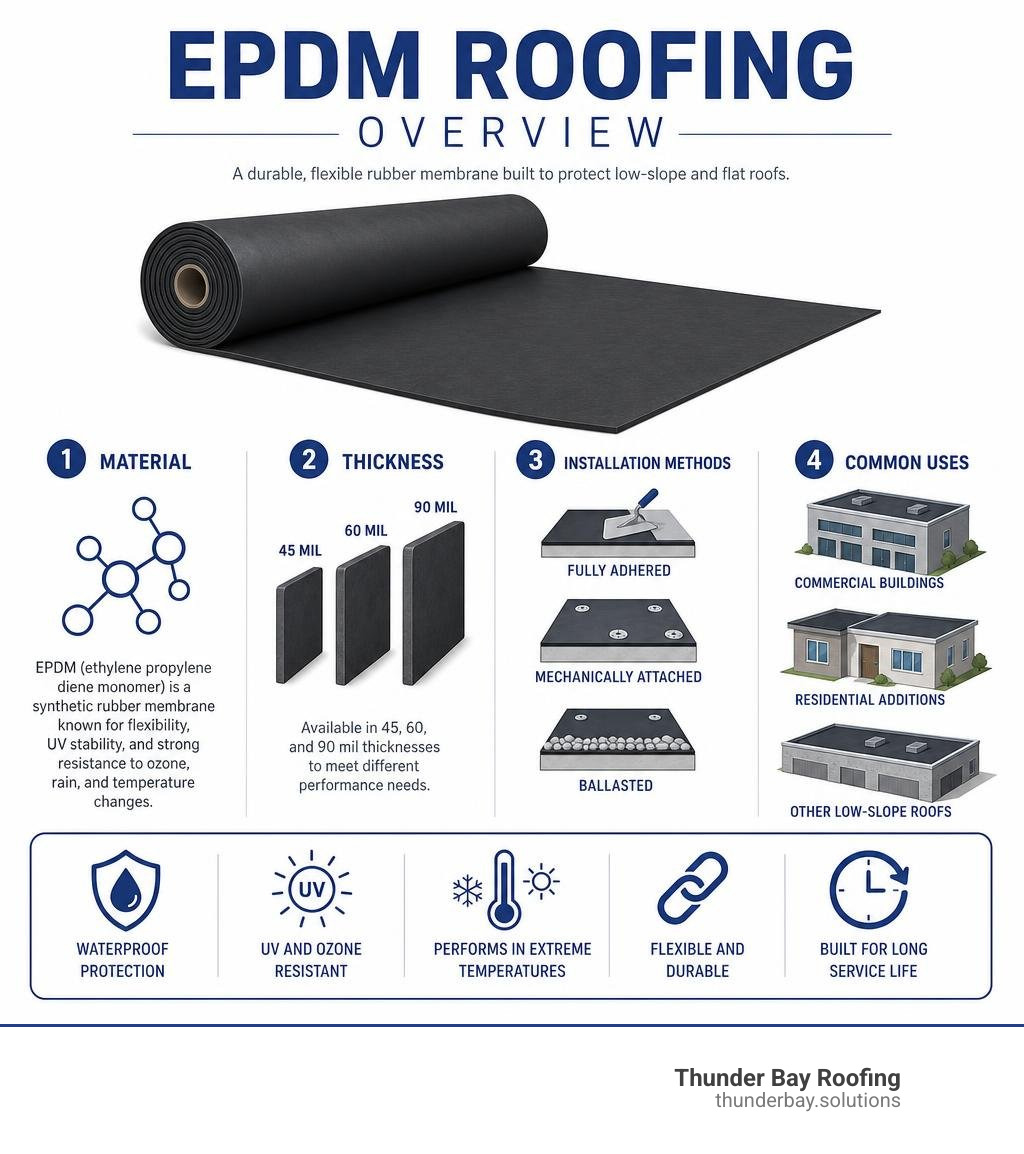
EPDM stands for ethylene propylene diene monomer, and it is valued for flexibility, UV stability, and strong resistance to ozone, rain, and changing temperatures.
- Available in 45, 60, and 90 mil thicknesses
- Sold in wide sheets, often reducing the number of leak-prone seams
- Installed as a fully adhered, mechanically attached, or ballasted system
- Common on commercial buildings, residential additions, and other low-slope roofs
- Built for long service life when the membrane, seams, drainage, and flashing details are properly installed
While black EPDM absorbs more heat than white reflective membranes, its proven weather resistance and elasticity make it a serious option for roofs exposed to Florida hurricane season, intense UV, daily afternoon storms, wind-driven rain, and seasonal movement. Pasco and Hillsborough County permit and wind-mitigation requirements also make proper system selection and professional installation critical.
I’m Tyler Wood, owner of Thunder Bay Home Solutions and Thunder Bay Roofing, where I lead roofing work designed for demanding Florida weather. My experience with low-slope roof systems, inspections, repairs, and replacements helps property owners evaluate EPDM roofing with a practical focus on waterproofing, code compliance, and long-term value.
Understanding EPDM Physical Properties and Technical Specifications
Ethylene propylene diene monomer (EPDM) is a single-ply synthetic rubber membrane formulated primarily from ethylene and propylene, which are raw chemical byproducts derived from oil and natural gas. During manufacturing, these ingredients undergo a vulcanization process that chemically cross-links the polymers into a single monolithic sheet. This molecular structure gives epdm roofing exceptional structural memory, allowing the sheet to stretch and return to its original shape without losing its watertight bond or structural integrity.
Standard single-ply rubber membranes comply with strict engineering standards established under ASTM D 4637 (Type I for non-reinforced synthetic rubber sheets). The chemical composition renders the material inherently stable under continuous ultraviolet radiation and high atmospheric ozone levels. Unlike asphaltic materials that dry out, crack, or release volatile oils over time, vulcanized rubber maintains its physical elasticity across extreme thermal cycles ranging from -49°F (-45°C) up to 176°F (80°C).
For a complete breakdown of material benchmarks, review our detailed guide on The Ultimate Guide to 45 Mil EPDM Specifications.
Understanding Thicknesses and Roll Sizes in EPDM Roofing
EPDM single-ply roofing membranes come in three core commercial thicknesses: 45 mil (0.045 inches), 60 mil (0.060 inches), and 90 mil (0.090 inches). A 45 mil sheet measures roughly the thickness of a U.S. dime and serves as an entry-level membrane for small low-slope roofs, dormers, and residential porches. Standard commercial projects typically specify 60 mil membrane for enhanced tear and puncture resistance, while heavy-duty 90 mil membranes are selected for long-term municipal or institutional installations requiring maximum durability. Specialized fiber-reinforced self-adhesive membranes are also manufactured at 52 mil overall thickness.
| Membrane Gauge | Inches | Relative Thickness | Primary Application | Expected Life Span |
|---|---|---|---|---|
| 45 Mil | 0.045″ | Thickness of a dime | Light residential low-slope roofs, residential dormers | 20 – 30 Years |
| 52 Mil (Reinforced) | 0.052″ | Self-adhered + internal scrim | Specialized overlay repairs, residential porches | 25 – 35 Years |
| 60 Mil | 0.060″ | Standard commercial thickness | Commercial flat roofs, residential additions | 30 – 45 Years |
| 90 Mil | 0.090″ | Heavy-duty structural gauge | High-traffic commercial roofs, extreme conditions | 45 – 50+ Years |
Roll width availability represents one of EPDM’s primary structural advantages. Manufacturers produce continuous sheets ranging from 7.5 feet up to 50 feet wide, and lengths extending up to 100 feet. A single continuous 25′ x 50′ or 50′ x 100′ sheet can cover an entire low-slope residential addition or commercial section without a single field seam. Eliminating field seams drastically reduces potential leak points. Review technical sizing parameters directly on the official JM EPDM NR 45 mil Data Sheet.
Material Performance: Tensile Strength, Elongation, and Weather Resistance
Unreinforced vulcanized EPDM possesses extraordinary physical elasticity. Under standard ASTM testing, non-reinforced 45 mil EPDM exhibits a minimum tensile strength of 1,686 psi (far exceeding the ASTM D 4637 standard minimum of 1,305 psi) and an ultimate elongation capacity of 451%. Premium 60-mil non-scrim rubber reaches elongation rates up to 465%, while heavy-duty 90-mil sheets test at 1,604 psi tensile strength with 426% elongation.
This high stretch capacity allows EPDM membranes to expand and contract as sub-roof structural decking shifts during dramatic temperature changes. Additionally, EPDM exhibits a water absorption mass rating below 0.55% (well under the maximum 8.0% limit set by ASTM standards).
Membranes are available primarily in black, gray, and white variants. Standard black EPDM exhibits a thermal emissivity rating of 0.88 and a solar reflectivity of 0.06. In warmer southern climates such as Pasco and Hillsborough Counties, white EPDM or reflective topcoat sealants are often applied to reflect solar heat and lower cooling costs.
Key Advantages and Common Applications of EPDM Roofing
EPDM synthetic rubber ranks among the longest-lasting low-slope roofing systems in the world, with field-proven service lives exceeding 50 years. Its flexibility prevents fatigue cracking caused by building thermal expansion. Because synthetic rubber does not contain volatile plasticizers that migrate out over time, the membrane does not become brittle with age.
Our team at Thunder Bay Roofing frequently recommends EPDM for low-slope applications because it offers exceptional lifecycle value. It requires minimal maintenance, resists impact damage from moderate hail, and withstands standing water better than multi-ply asphalt systems.
Ideal Applications for Low-Slope Commercial and Residential Structures
Single-ply EPDM roofing functions exceptionally well across a wide range of low-slope architectural assemblies:
- Commercial Flat Roofs: Ideal for retail centers, warehouses, office buildings, and industrial facilities requiring large, uninterrupted waterproofing coverage.
- Residential Additions and Porches: Perfect for modern residential room extensions, flat patio covers, lanais, and dormers where roof pitch falls below 2:12.
- Green Roof Waterproofing Substrates: Serves as a reliable, root-resistant baseline waterproofing layer under vegetative roof gardens and protected membrane assemblies.
- Balcony and Patio Overlays: Reinforced fleece-backed EPDM sheets handle light foot traffic and underlying deck expansion when installed under protective pavers.
When building owners in Wesley Chapel FL or Land O Lakes FL need reliable waterproofing, choosing the right material gauge and substrate assembly prevents costly water intrusion during tropical rainstorms.
Comparing EPDM Roofing to TPO and PVC Single-Ply Membranes
Understanding how EPDM compares to thermoplastic single-ply membranes like Thermoplastic Polyolefin (TPO) and Polyvinyl Chloride (PVC) helps building managers make informed decisions regarding energy efficiency, chemical exposure, and installation methods.
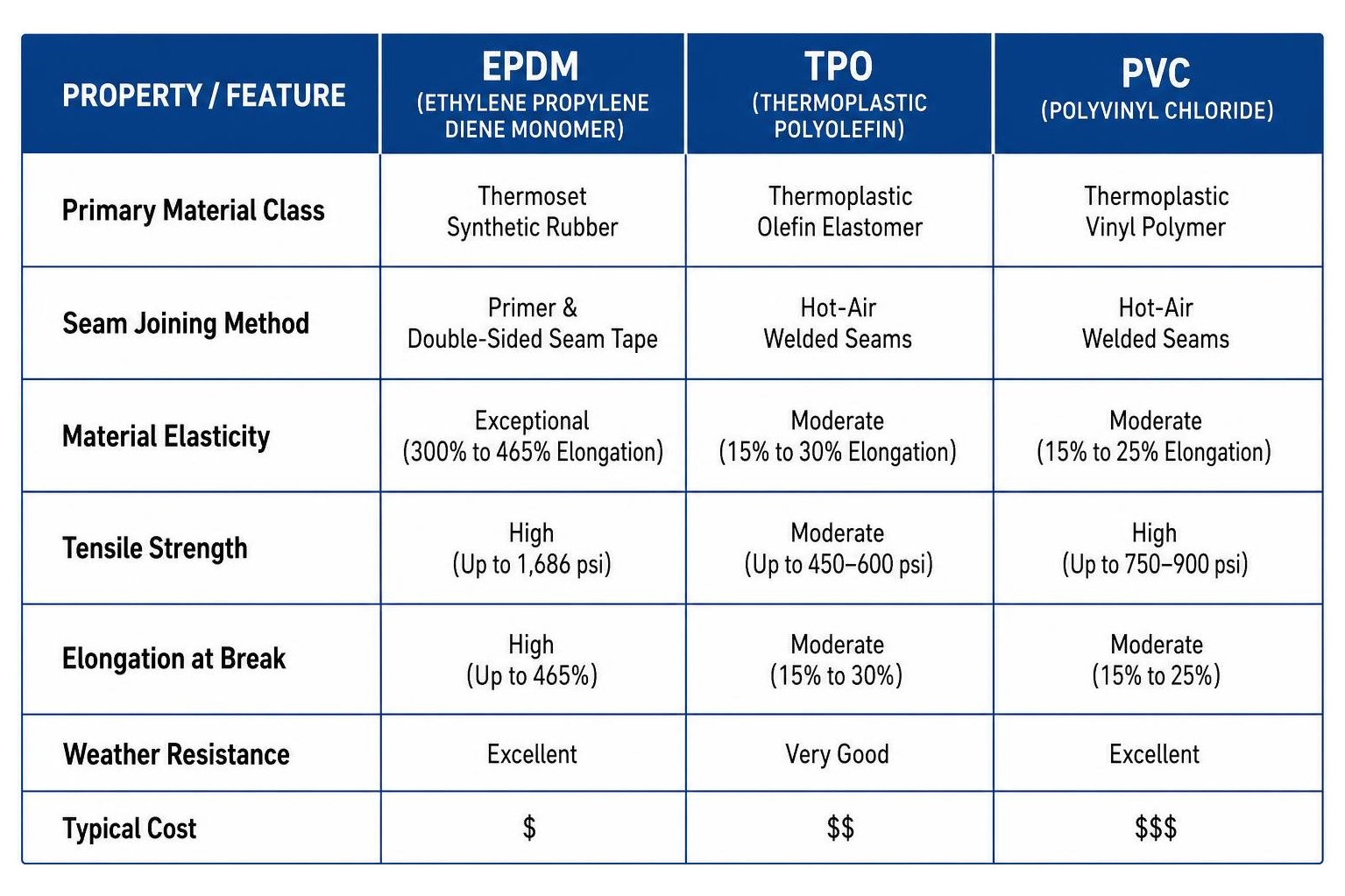
| Property / Feature | EPDM (Ethylene Propylene Diene Monomer) | TPO (Thermoplastic Polyolefin) | PVC (Polyvinyl Chloride) |
|---|---|---|---|
| Primary Material Class | Thermoset Synthetic Rubber | Thermoplastic Olefin Elastomer | Thermoplastic Vinyl Polymer |
| Seam Joining Method | Primer & Double-Sided Seam Tape | Hot-Air Welded Seams | Hot-Air Welded Seams |
| Material Elasticity | Exceptional (300% to 465% Elongation) | Moderate (15% to 30% Elongation) | Moderate (15% to 25% Elongation) |
| Solar Reflectivity | Low (Black: 0.06) / High (White variant) | High (Standard White: 0.70 – 0.80) | High (Standard White: 0.75 – 0.85) |
| Chemical & Oil Resistance | Fair (Sensitive to petroleum/grease) | Good (Resistant to animal fats) | Excellent (High chemical/grease resistance) |
| Expected Service Lifespan | 30 to 50+ Years | 15 to 25 Years | 20 to 30 Years |
While TPO and PVC utilize hot-air welded seams, EPDM relies on advanced polymer seam tapes and primers that form continuous chemical cross-links. EPDM offers superior elasticity compared to TPO or PVC, preventing membrane splits when building structural decks shift. To read more about single-ply material comparisons, explore The Ultimate Breakdown of Flat Roof Membrane Types and Systems.
EPDM Installation Methods and Seam Sealing Techniques
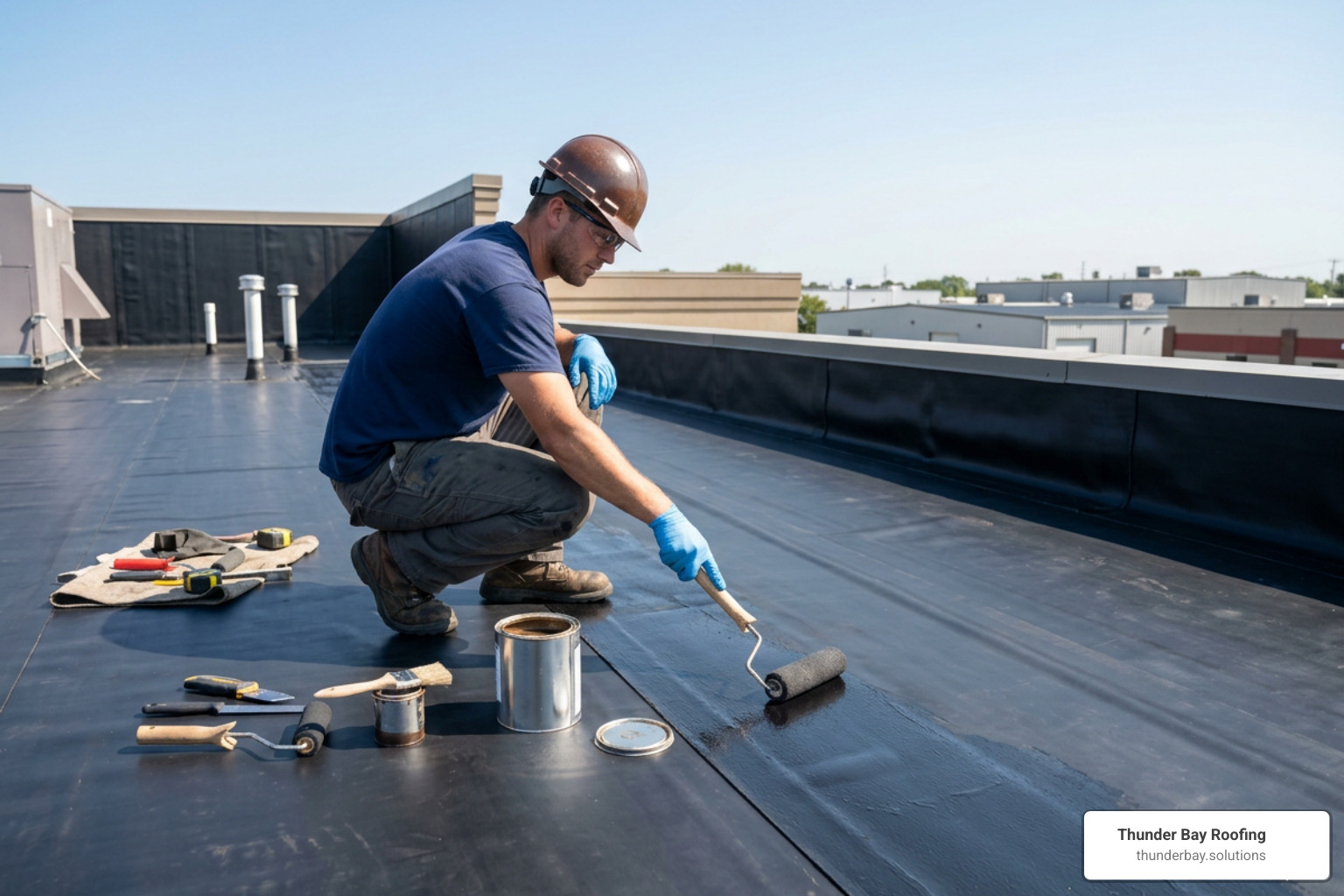
Proper installation of an epdm roofing system requires specialized substrate preparation, precise environmental controls, and professional craftsmanship. Substrates must be completely dry, smooth, and free of debris to ensure structural adhesion. Polyisocyanurate (polyiso) insulation boards or high-density cover boards are fastened to the deck using heavy-duty stress plates and screws, providing key thermal performance and structural backing for low-slope assemblies.
In Central Florida, professional installations must meet strict Pasco and Hillsborough County permit and wind-mitigation requirements to withstand severe weather. High humidity, intense UV exposure, daily afternoon storms, and extreme wind uplift during Florida hurricane season demand strict adherence to adhesive curing times and climate-controlled material handling.
Fully Adhered vs. Mechanically Attached vs. Ballasted Systems
EPDM single-ply systems are installed using three primary commercial application methods:
- Fully Adhered System: Low-VOC bonding adhesive secures the rubber membrane to the substrate board. Fully adhered assemblies offer exceptional wind uplift resistance, making them ideal for handling severe wind-driven rain in Oldsmar FL and Hillsborough County during hurricane season.
- Mechanically Attached System: Continuous rubber sheets are secured along membrane side laps using engineered stress plates and mechanical fasteners anchored into the structural roof deck, with seams spliced over the fastener lines.
- Ballasted System: Rubber sheets are laid loose over insulation and held down using smooth river gravel or pavers. While cost-effective, ballasted systems require structural engineering evaluations to ensure the roof framing can support the heavy ballast weight under severe storm conditions.
Flashings, Seam Taping, and Professional Watertight Detail Principles
Critical transition areas and membrane seams require professional engineering to prevent water ingress during relentless tropical rain. Modern single-ply rubber assemblies utilize advanced double-sided synthetic seam tapes and specialized polymer primers to form high-strength chemical cross-links between continuous sheets.
Professional roofers engineer watertight details using specialized components designed for extreme weather exposure:
- Polymer-primed lap joints joined with high-tack butyl seam tape and finished with protective edge sealants
- Custom-molded pipe boots and flashing accessories designed to maintain flexibility under intense UV exposure and thermal expansion
- Heavy-duty metal termination bars mechanically anchored with stainless fasteners at parapets and vertical wall transitions to resist wind-driven rain penetration
For detailed technical specifications, commercial builders rely on industry resources like the RubberGard EPDM Application Guide and standard system standards in the EPDM Fully Adhered Roofing System reference documentation.
Maintenance, Professional Repair Evaluation, and System Costs
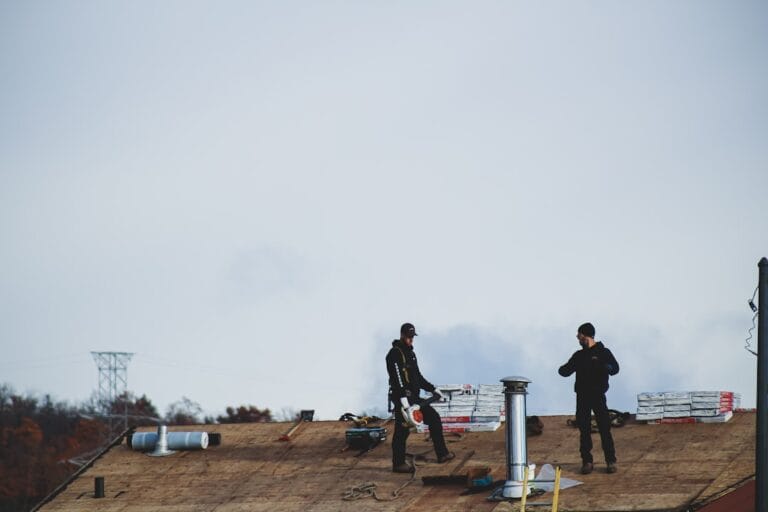
Regular maintenance keeps epdm roofing systems in top condition over decades of service, but inspection and repair decisions should be handled by qualified roofing professionals. Professional visual inspections should occur twice a year – once in spring and once in autumn – as well as after major severe weather events. A low-slope roof evaluation checks for clogged scuppers and drains, pulling or missing termination bar sealant, storm-debris punctures, membrane shrinkage, ponding water, and seam separation.
In areas like Lutz FL, high summer humidity, intense sunlight, daily afternoon storms, and frequent severe weather can stress roof perimeters. Catching minor flashing pulls or clogged drains early prevents moisture from migrating beneath insulation boards, where trapped water can increase repair costs and reduce system life. To schedule a professional low-slope roof evaluation, property owners can call our team directly at 813-555-0199.
Material Pricing, Labor Factors, and System Warranties
Material costs for EPDM rubber membranes vary based on thickness, sheet width, and overall square footage:
- A standard 45-mil 25′ x 5′ roll costs approximately $133.75 ($1.07 per sq ft for materials).
- A larger 45-mil 25′ x 50′ continuous commercial roll costs approximately $1,312.00 ($1.05 per sq ft for materials).
- Total installed system costs – including substrate tear-off, polyiso insulation boards, bonding adhesives, seam tapes, perimeter flashings, local building permits, and skilled labor – typically range from $6.00 to $12.00 per square foot depending on roof complexity and wind-uplift requirements.
System warranties vary depending on material thickness and system configuration:
- Standard 45 mil assemblies carry 15-year to 20-year manufacturer material warranties.
- Heavy-duty 90 mil fully adhered commercial assemblies can qualify for up to 30-year limited manufacturer system guarantees, such as those detailed in the JM EPDM NR 90 mil Data Sheet and third-party commercial criteria in the Standard for EPDM Membrane Roof Systems. European quality compliance options are also established under FIX-R EPDM Systems documentation.
Professional Maintenance and Elastomeric Restoration Principles
When an aged EPDM membrane experiences localized mechanical damage, storm punctures, or wear, licensed professionals determine whether the roof is a candidate for localized repair, coating restoration, or full replacement. The inspection typically documents membrane thickness, seam condition, flashing adhesion, drainage performance, moisture intrusion, and compatibility with any proposed restoration material.
Professional restoration uses system-compatible products selected for the existing membrane and Florida exposure conditions. On sound rubber substrates, high-solids white silicone or acrylic elastomeric roof coatings can create a seamless reflective barrier against intense UV radiation. Reflective topcoats significantly lower roof surface temperatures, improve energy efficiency, and protect underlying membranes against thermal degradation when the roof is suitable for restoration.
To explore liquid restoration options in detail, read our guide on how to Coat Your Way to a Longer Lasting Roof.
Frequently Asked Questions About EPDM Systems
How long does an EPDM single-ply rubber roof last?
An EPDM single-ply rubber roof has an expected service life ranging from 30 to 50 years. Because vulcanized synthetic rubber contains no volatile plasticizers, it resists embrittlement caused by continuous UV exposure and severe thermal cycling. Proper seaming, adequate roof slope (minimum 2% or 1/4″ per foot), and routine drain maintenance ensure maximum longevity.
What is the difference between 45 mil, 60 mil, and 90 mil EPDM membranes?
The main differences are thickness, puncture resistance, and service lifespan. 45 mil (0.045″) serves as an economical choice for light residential applications; 60 mil (0.060″) is the standard commercial thickness offering excellent tear resistance; and 90 mil (0.090″) is a heavy-duty membrane designed for high-traffic flat roofs or institutional structures seeking 30-year manufacturer system guarantees.
Can single-ply EPDM rubber roofing be installed over existing asphalt roofs?
Single-ply EPDM rubber must never be installed directly over asphaltic roofing plies, such as built-up roofing (BUR) or modified bitumen, because petroleum residues degrade synthetic rubber. When recovering an asphalt roof, contractors must install an approved separator cover board or polyiso insulation layer between the old asphalt roof and the new EPDM membrane.
Conclusion
EPDM single-ply synthetic rubber roofing remains one of the most reliable waterproofing solutions for low-slope commercial buildings and residential flat roof additions in Pasco and Hillsborough Counties. Its combination of 30- to 50-year service life, extreme elasticity, UV stability, and continuous sheet options makes it an outstanding choice for property owners seeking long-term protection.
Selecting the right membrane thickness (45 mil, 60 mil, or 90 mil) and installation method (fully adhered, mechanically attached, or ballasted) depends on building height, wind uplift requirements, structural load capabilities, and project budget. In Wesley Chapel, Lutz, Land O Lakes, and Oldsmar, installing EPDM systems according to local permit and wind-mitigation requirements helps roofs withstand Florida hurricane season, intense UV exposure, wind-driven rain, and daily afternoon storms.
At Thunder Bay Roofing, our team brings local weather expertise, full licensing, and specialized experience to every low-slope project. Whether you need a comprehensive roof inspection, minor seam repair, coating restoration, or complete single-ply replacement, we provide clear guidance tailored to your building. Explore our comprehensive EPDM roofing installation services today to request a professional consultation and protect your investment for decades to come.