
How to Get Rid of Urgent Flat Roof Repair Issues in Wesley Chapel
Diagnosing Common Failure Points and Locating Leaks
To resolve urgent flat roof repair issues in Wesley Chapel, Lutz, Land O Lakes, and Oldsmar, property owners must quickly isolate the water source, arrange temporary wet-seal stabilization or drainage diversion, and trace moisture travel back to exterior flashings or unbonded seams. Flat roof leaks rarely occur in open spans; most stem from perimeter terminations, penetrations, and mechanical curbs under hydrostatic pressure. Executing proper diagnosing flat roof leaks methods eliminates guesswork and protects the underlying deck from rot. Partnering with a trusted Florida roofing contractor ensures fast stabilization and long-term structural integrity.
Capillary action frequently draws wind-driven moisture upward behind loose parapet flashings and unsealed termination bars during severe Central Florida squalls. When water slips behind these perimeter boundaries, it migrates beneath the top membrane without showing immediate exterior signs of wear. Over time, thermal expansion causes trapped air and moisture pockets to expand under intense solar exposure, forming pronounced blisters and accelerating seam delamination across modified bitumen or single-ply sheets.
Uncoated asphalt-based systems eventually succumb to severe alligatoring, where deep cracking patterns compromise the waterproof barrier. Property owners facing sudden interior drips must prioritize professional roof leak detection to pinpoint underlying breaches before moisture penetrates the structural sub-deck.
Pinpointing Lateral Water Travel and Hidden Entry Points
Interior ceiling drips almost never align vertically with the exterior membrane breach on a low-slope roof. Water enters through a puncture or split, encounters an impermeable insulation layer or metal decking rib, and travels laterally across joists for dozens of feet before finding an interior opening.
To trace this path, technicians perform interior benchmarking by measuring the coordinates of ceiling stains relative to two fixed exterior walls, then projecting those coordinates onto the roof surface. Starting at that benchmark, inspectors examine all upslope areas, evaluating suspect seams, vent boots, and parapet transitions.
Attic inspections verify water trails along structural rafters back to the highest wet point. Non-destructive moisture meters, infrared thermography at dusk, and systematic low-to-high hose testing isolate elusive punctures without puncturing sound roofing assemblies.

Identifying Membrane Chemistry: TPO, PVC, EPDM, and Built-Up Systems
Selecting an effective repair strategy requires correctly identifying the chemical composition of the roofing membrane. Mixing incompatible chemistries – such as applying solvent-heavy asphalt mastic over synthetic rubber – leads to rapid material degradation and catastrophic failure. Understanding the primary flat roof membrane types and systems ensures that any planned restorative work adheres properly to the underlying substrate.
- Thermoplastic Polyolefin (TPO): Typically white or light gray sheets with heat-welded seams. The surface feels smooth and slightly textured with embedded reinforcing scrim.
- Polyvinyl Chloride (PVC): Smooth, flexible plastic sheets that are highly resistant to chemical and grease exposure, featuring hot-air welded seams.
- Ethylene Propylene Diene Monomer (EPDM): Synthetic black or dark gray rubber membrane that resembles an inner tube, utilizing adhesive tape or liquid bonding glues at lap joints.
- Modified Bitumen (Mod-Bit): Granulated or smooth multi-ply asphalt sheets installed in rolls, featuring torch-applied, self-adhered, or cold-mastic seams.
- Built-Up Roofing (BUR): Alternating layers of heavy asphalt felt and hot tar, traditionally topped with an embedded gravel ballast or mineral cap sheet.
Complete Guide to Flat Roof Repair by Membrane System
Different roofing systems require distinct mechanical, chemical, and thermal repair processes to maintain structural integrity. The table below outlines how professional contractors approach each system:
| Membrane System | Common Failure Modes | Primary Repair Methodology | Critical Surface Preparation | Compatible Sealants & Adhesives |
|---|---|---|---|---|
| EPDM Rubber | Bridging seams, shrinkage tears, puncture voids | Cleaned, primed uncured cover strips or cured EPDM patches | Dedicated EPDM wash, weathered membrane cleaner | Synthetic rubber primers, lap sealants, butyl splice tape |
| TPO Single-Ply | Seam debonding, mechanical stress tears | Hot-air welded TPO patches or peel-and-stick detail membranes | Solvent cleaning to remove oxidation and grime | TPO primers, heat-activated welds, specialized TPO edge sealants |
| PVC Single-Ply | Welded seam splits, chemical or puncture damage | High-temperature hot-air robotic or hand welding with PVC patches | Heavy degreasing and residue-free solvent wipe | Heat fusion welding, specialized liquid PVC lap seamers |
| Modified Bitumen | Granule loss, seam fish-mouths, blister splits | Three-course mastic sandwich patch or torch-applied cap sheet | Wire-brushing loose mineral granules and oxidized bitumen | ASTM D4586 asphalt plastic cement, SBS-modified mastic |
Executing Professional Asphalt Membrane Maintenance
Asphalt-based roofs require specialized composite reinforcement to withstand ongoing building movement and heavy UV radiation. Property owners looking to maintain aging systems should have a licensed roofer evaluate whether professionals can patch a leaky flat asphalt roof or whether deterioration has progressed beyond localized repair.
Adhering to strict three-course asphalt patching standards creates an elastomeric bridge over fractures, splits, and cut-out blisters. Professional repairs use compatible ASTM D4586 flashing cement with glass fiber scrim or #30 asphalt-saturated felt as a reinforced assembly, and the perimeter is finished so water sheds cleanly rather than collecting at the repair edge.
Because bare asphalt cement degrades rapidly under sunlight, cured asphalt repairs require a protective coating. Applying a fibered aluminum topcoat or re-embedding clean gravel ballast reflects harmful solar rays and adds 3 to 5 years of service life to the repaired section.
Single-Ply Heat Welding vs Peel-and-Stick Adhesive Patches
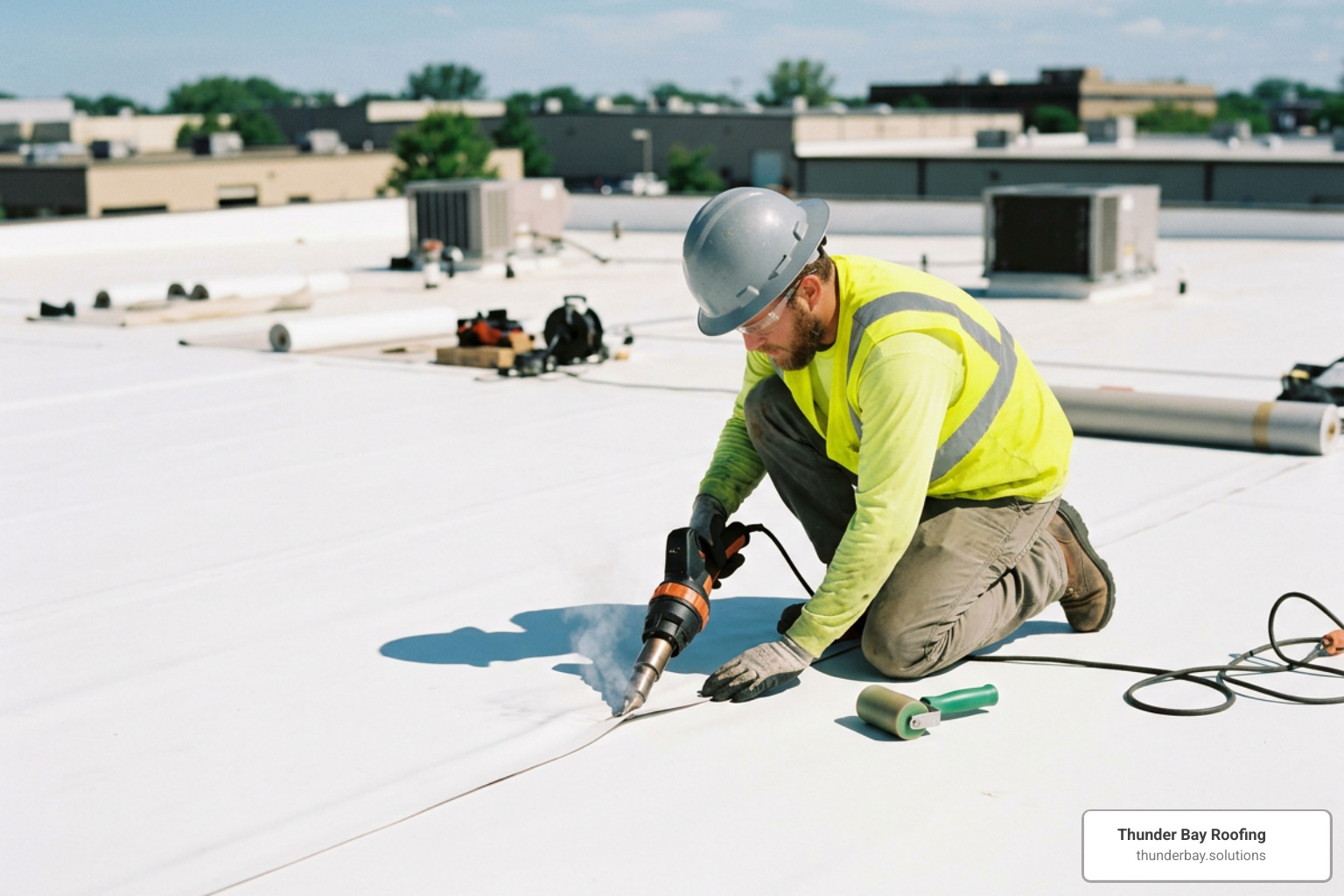
Thermoplastic membranes like TPO roofing rely on thermal fusion rather than liquid glues for permanent waterproofing. Professional roofers utilize calibrated hot-air hand welders and silicone seam rollers to melt the overlapping layers of TPO or PVC together, creating a continuous, monolithic bond that resists wind uplift and ponding water.
In contrast, synthetic rubber systems such as EPDM roofing cannot be heat-welded due to their vulcanized chemical structure. Instead, repairs require specialized solvent primers that activate the rubber before applying peel-and-stick cured cover strips or butyl seam tapes.
Applying unapproved asphalt mastics to EPDM triggers molecular swelling, dissolving the rubber and creating larger structural leaks.
When to Choose Full Replacement Over Flat Roof Repair
Targeted repairs make sense for isolated, localized damage, but older systems eventually reach a point where continued patching is no longer cost-effective. Roofing professionals adhere to the 25% failure rule: when deteriorated or damaged areas exceed 25% of the total roof surface, a comprehensive system replacement is necessary.
Saturated sublayers represent another critical factor. When underlying polyisocyanurate insulation boards become waterlogged, they produce a noticeable squelching sound underfoot and lose all thermal resistance.
Trapped moisture rots timber decking, corrodes steel roof pans, and breeds hazardous interior mold. In these scenarios, ongoing patch attempts simply trap moisture inside the building envelope, making a complete commercial roof replacement the only sound path forward.
Emergency Fixes, Wet Weather Protocols, and Material Costs
Active leaks during heavy storms require immediate stabilization to protect commercial assets, mechanical equipment, and interior living spaces. While long-term membrane bonding requires dry conditions, emergency response teams deploy specialized wet-patch compounds formulated to adhere directly to wet substrates. When structural integrity is compromised during severe weather, property owners rely on rapid emergency tarping to secure the building envelope until permanent repairs can proceed.
In Wesley Chapel, Lutz, Land O Lakes, Oldsmar, and the surrounding Central Florida service area, flat roofs face severe environmental stresses, including intense UV degradation, daily afternoon storms with wind-driven rain, and the destructive wind uplift of the Florida hurricane season. Any permanent restoration or major repair must also satisfy strict Pasco and Hillsborough County permit and wind-mitigation requirements to guarantee structural resilience.
Wet Surface Applications and Weather Emergency Triage
Standard roofing cements fail when applied over standing water because the moisture barrier prevents chemical bonding. Emergency repairs require SBS-modified, rubberized asphalt mastics meeting ASTM D3409 standards for underwater adhesion. These heavy-bodied mastics displace water molecules to form an instant seal across punctures, cracked flashing collars, and weeping seams.
Emergency wet patches are temporary triage solutions designed to stop water ingress until fair weather allows for thorough drying and permanent repairs. Specialized asphalt patch mastics require approximately 30 days to fully release solvents and outgas before contractors can apply permanent reflective coatings or hot-air welded overlays.
Budgeting for Targeted Patches, Fluid Coatings, and Overlays
Understanding the costs associated with various repair and restoration strategies allows building owners to manage operational budgets effectively. Minor targeted repairs performed by licensed professionals typically range from $150 to $600 for small puncture patches, seam resealing, or pipe boot replacements. More complex flashing reconstructions around commercial HVAC curbs range between $300 and $1,000.
| Repair or Restoration Scope | Estimated Cost (Installed) | Expected Added Lifespan | Best Application |
|---|---|---|---|
| Small Targeted Patch / Seam Reseal | $150 – $600 | 3 – 5+ Years | Isolated mechanical punctures, minor lap splits |
| Major Penetration & Flashing Repair | $300 – $1,000 | 5 – 10 Years | Deteriorated HVAC curbs, parapet wall transitions |
| Fluid-Applied Silicone Coating | $1.50 – $5.00 / sq. ft. | 10 – 15 Years | Aging, watertight roofs needing UV restoration |
| Single-Ply PVC / TPO Roof Recover | $2.50 – $4.00 / sq. ft. | 15 – 20 Years | Dry sublayers with weathered top membranes |
| Full Tear-Off and Deck Replacement | $4.00 – $8.99 / sq. ft. | 20 – 30 Years | Saturated insulation, extensive deck rot |
When an existing roof membrane is weathered but remains completely dry and structurally sound underneath, applying fluid-applied roof coatings provides an economical alternative to complete tear-offs. High-solids silicone coatings resist ponding water, reflect over 80% of ultraviolet rays, and significantly reduce cooling loads across commercial properties.
Frequently Asked Questions About Commercial and Residential Flat Roofs
How do I know if a flat roof leak is causing structural deck rot?
Structural deck rot manifests through tangible physical changes in the roof assembly and interior ceilings. The most common sign is a soft, spongy feeling underfoot when walking the roof field, indicating that underlying plywood, OSB, or timber decking has softened from persistent moisture exposure.
Internally, sagging drywall, peeling ceiling paint, persistent musty odors, and visible mold growth signal chronic water infiltration. If roof fasteners begin backing out or insulation produces an audible squelching sound when stepped on, the roof deck requires immediate professional structural evaluation.
Can I apply asphalt roofing cement directly onto an EPDM rubber roof?
No, asphalt-based roofing cement must never be applied to an EPDM synthetic rubber roof. The petroleum solvents contained within standard roofing cements and mastics trigger a destructive chemical reaction known as molecular swelling.
This reaction causes the synthetic rubber to distort, soften, and dissolve, turning a minor leak into a large, unrepairable tear within weeks. EPDM systems must only be maintained using manufacturer-approved solvent cleaners, dedicated rubber primers, and cured butyl-adhesive cover tapes.
How long does a reinforced composite flat roof patch last?
A professionally executed three-course reinforced composite patch on an asphalt or modified bitumen roof lasts between 3 and 5 years when properly protected from solar radiation. The overall lifespan depends heavily on surface preparation and ongoing UV shielding.
If the patch is coated with a reflective aluminum finish or elastomeric topcoat, it resists thermal cracking and outlasts bare asphalt repairs. On single-ply thermoplastic roofs like TPO and PVC, a proper hot-air welded patch creates a permanent fusion that typically lasts the remaining lifespan of the surrounding membrane.
Conclusion
Flat roof systems require precise diagnostics, chemical compatibility, and systematic moisture management to perform reliably over their service life. Addressing leaks quickly prevents water from migrating laterally into insulation bays and degrading the structural roof deck.
At Thunder Bay Roofing, our team delivers comprehensive leak evaluations, structural deck assessments, and customized commercial and residential solutions for Wesley Chapel, Lutz, Land O Lakes, and Oldsmar properties engineered to withstand severe tropical storms and intense year-round sun.
Explore our complete range of professional roof repair services to protect your property and extend the operating life of your roof assembly.