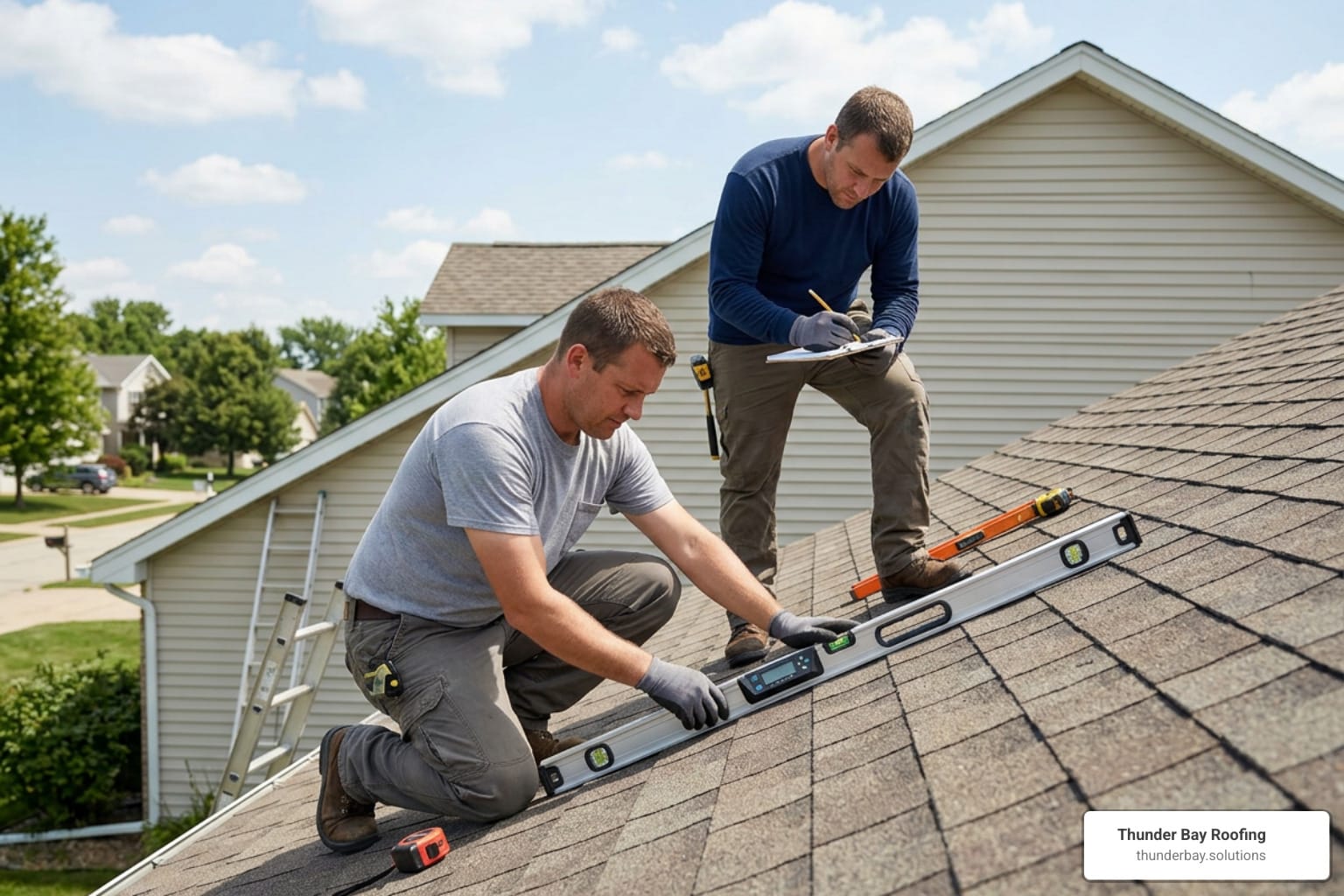

Understanding Granule Loss and Hail Damage Claims
When Hail Hits Your Roof: What Granule Loss Actually Means
Granule loss from hail damage is one of the most misunderstood roofing issues homeowners face — and one of the most disputed in insurance claims. If you suspect your home has been impacted by a recent storm, securing reliable professional roofing services is the first step to protecting your investment.
Quick answer: Does granule loss from hail mean your roof is damaged?
- It depends. Granule loss alone does not automatically qualify as storm damage.
- If hail knocks granules off a newer, healthy roof and exposes the asphalt mat, that is functional damage.
- If your roof is already heavily deteriorated and granules are flaking off naturally, that is normal wear and tear — not a covered loss.
- True hail damage requires evidence of bruising, punctures, or fractures in the shingle mat, not just missing granules.
- The threshold hail size to cause visible damage to newer shingles is 1 to 1.25 inches in diameter.
After a hailstorm, it is completely normal to spot a pile of colorful granules at the bottom of your downspouts and wonder if your roof is ruined. But a pile of granules tells only part of the story. The real question is what caused them to come off — and what condition the shingles were in before the storm hit.
Here in Wesley Chapel and the wider Tampa Bay area, Florida’s intense UV exposure, summer heat, and severe storm activity create a perfect environment for granule loss — whether from hail, aging, or both. Understanding the difference is critical before you file a claim or schedule a replacement.
I’m Tyler Wood, owner of Thunder Bay Roofing, and through years of inspecting Florida roofs for granule loss and hail damage, I’ve seen how often normal weathering gets misidentified as storm damage — and vice versa. Let me walk you through exactly how to tell the difference.
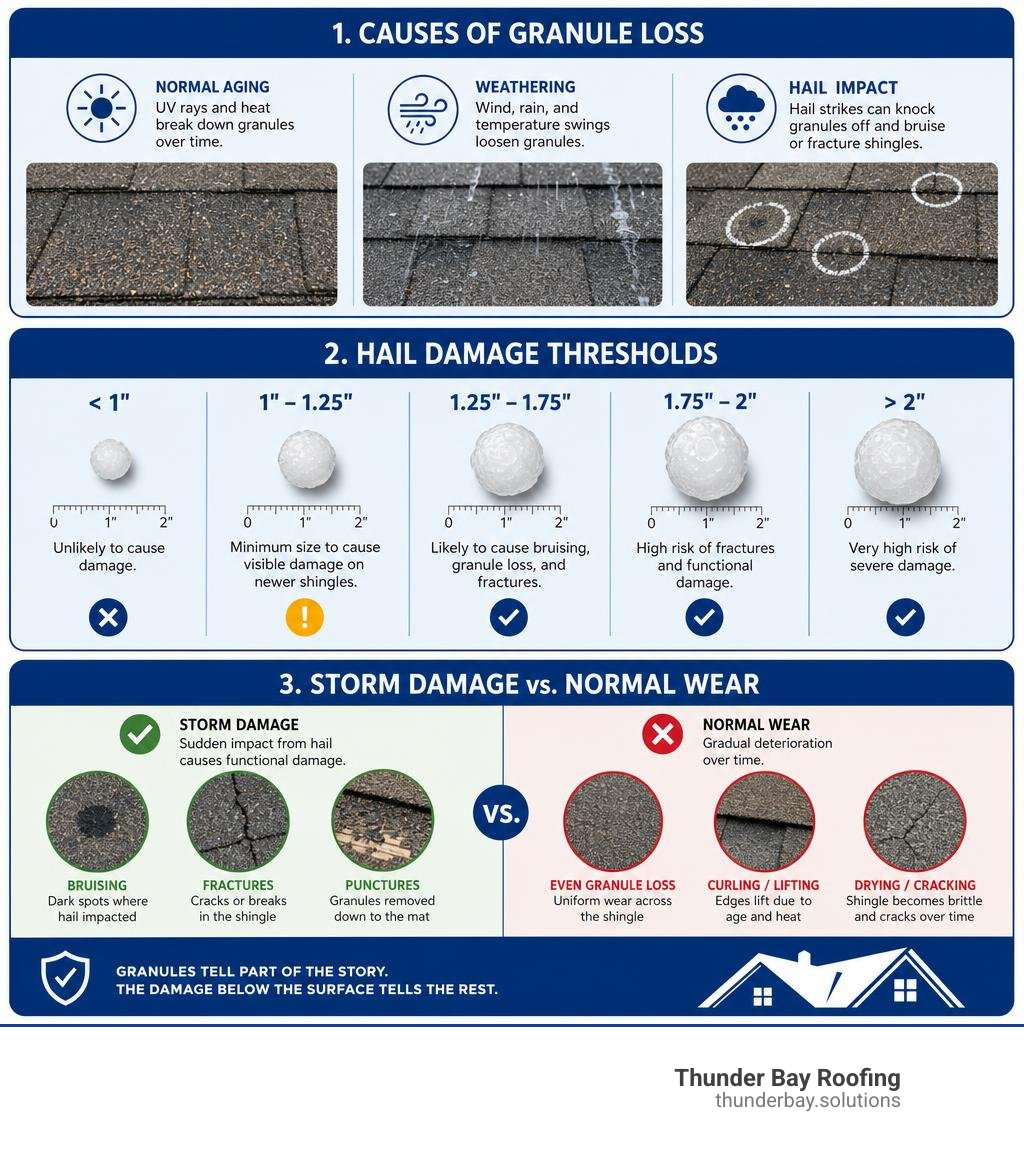
Granule loss hail damage terms to know:
What is Granule Loss Hail Damage?
To understand granule loss hail damage, we must first look at how asphalt shingles are manufactured. A typical modern asphalt shingle is composed of three main layers by weight: approximately one-third embedded mineral granules, one-third asphalt coating, and one-third mineral stabilizers or fillers wrapped around a fiberglass or organic mat core.
The mineral granules are not just there for aesthetics. They are crushed stone coated in a ceramic material that serves two critical purposes: shielding the underlying asphalt layer from ultraviolet (UV) radiation and providing fire resistance.
During manufacturing, excess granules are applied to ensure complete coverage. Between 12% and 15% of these surface granules must be removed from new shingles before the underlying asphaltic mat is even exposed. These excess granules, sometimes called “riders” or “clingers,” naturally wash away during the first few rains of a newly installed roof.
When a severe storm hits, the key question is whether the resulting granule loss is functional or cosmetic. For a comprehensive look at the scientific consensus, Scientific research on shingle composition and granule loss provides deep insight. If high-velocity hailstones strike a roof, they can physically displace firmly embedded granules. If this displacement exposes the asphalt mat underneath, it can lead to accelerated UV degradation and eventually require hail damage repair to prevent leaks.
Defining Functional vs. Cosmetic Granule Loss Hail Damage
The roofing and insurance industries draw a sharp line between functional and cosmetic damage:
- Functional Damage: This occurs when a hailstone impact causes physical punctures, tears, or fractures (bruises) in the shingle mat. This compromises the shingle’s structural integrity and its ability to shed water.
- Cosmetic Damage: This refers to the displacement of granules that alters the roof’s appearance but does not compromise the shingle’s water-shedding capabilities or expected service life.
A landmark ten-year weathering study conducted by Haag Engineering monitored shingles with varying percentages of granules manually removed (up to 70%). The study concluded that minor to moderate granule loss alone does not shorten a roof’s life or affect its water-shedding ability, provided the underlying shingle mat is not bruised, torn, or punctured.
However, if granule loss is severe enough to expose the black asphalt mat to Florida’s intense sunlight, the exposed asphalt will degrade rapidly. Over several seasons, this leads to cracking, splitting, and eventual water intrusion. For a complete breakdown of how to spot these differences, check out our ultimate guide to inspecting your roof for hail damage.
The Science of Hailstone Kinetic Energy and Shingle Resistance
The likelihood of a hailstone causing functional damage to an asphalt shingle is directly related to its kinetic energy. Kinetic energy increases exponentially with the size of the hailstone.
For example:
- 1-inch hail strikes a roof with the same kinetic energy as a 1 lb can of soup dropped from 1 foot.
- 1.75-inch hail strikes with the force of a 3 lb toaster dropped from 5 feet.
- 2-inch hail strikes with the energy of a 5 lb bottle of soda dropped from 5 feet.
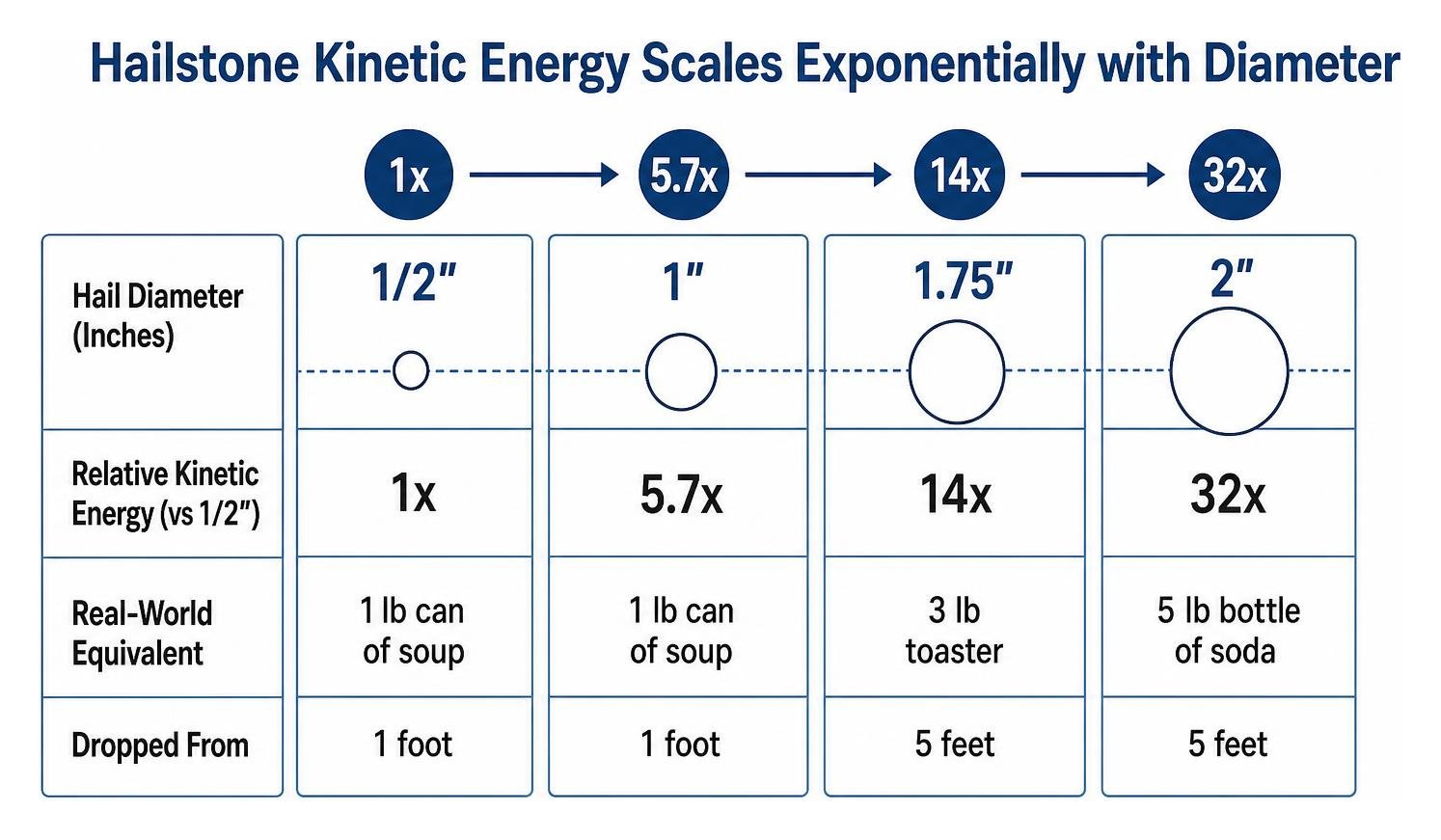
This energy scaling explains why larger hailstones easily fracture shingle mats, while smaller stones usually only displace loose granules.
| Hail Diameter (Inches) | Kinetic Energy Relative to 1/2″ Hail | Typical Damage Threshold by Shingle Type |
|---|---|---|
| 1/2″ | 1x | No functional damage to healthy shingles. |
| 3/4″ | 4x | May cause cosmetic granule displacement on older shingles. |
| 1″ | 13x | Damage threshold for aged organic mat-based shingles. |
| 1 1/4″ | 30x | Damage threshold for aged glass-fiber mat shingles. |
| 1 1/2″ | 60x | Damage threshold for thicker, aged laminated (architectural) shingles. |
| 1 3/4″ | 120x | High risk of functional mat bruising on all shingle types. |
| 2″ | 200x | Severe structural damage, punctures, and immediate failure. |
Distinguishing Storm Damage from Normal Roof Aging
Asphalt shingles naturally shed granules throughout their entire lifespan. A healthy roof is designed to naturally shed 2% to 4% of its granules on an annual basis simply due to gravity, wind, rain, and thermal expansion.
In Lutz, Land O’ Lakes, and Wesley Chapel, roof surface temperatures regularly exceed 150°F to 160°F during the summer. This extreme heat expands the asphalt, while afternoon thunderstorms rapidly cool it down. This constant thermal cycling gradually breaks down the asphalt-to-granule bond over time, causing granules to flake off naturally.
When assessing a roof, we must distinguish between this gradual, diffuse thinning and the sudden, localized impact of a hailstorm. Hail-caused granule loss typically exhibits a random, circular, or irregular pattern of freshly exposed black asphalt. Conversely, age-related wear shows up as widespread thinning across the entire slope, often concentrated in water-runoff channels.
Understanding these differences is essential when maintaining high-quality asphalt shingle roofing in West Central Florida.
Identifying Common Shingle Anomalies Mistaken for Hail
Many non-hail blemishes are frequently mistaken for storm damage. During a forensic roof inspection, we carefully look for these common shingle anomalies:
- Blisters: Caused by trapped moisture or gases expanding within the shingle during hot days, often accelerated by poor attic ventilation. Blisters leave circular loss areas but lack the physical mat bruising or indentation of a hail strike.
- Foot Scuffs (Marring): Occur when workers walk on hot, softened shingles. These scuffs scrape away granules in a directional, smeared pattern rather than a circular impact point.
- Adhesive Spots: Drops of self-sealing adhesive that accidentally drip onto the shingle surface during manufacturing or installation, which eventually weather away and leave small, bare spots.
- Cupping and Clawing: The curling of shingle edges due to age and moisture, which exposes the edges to accelerated erosion.
For a detailed technical guide on distinguishing these anomalies, refer to this Forensic analysis of wind and hail vs. deterioration.
How Roof Age and Pre-Existing Conditions Affect Hail Resistance
A roof’s resistance to hail is heavily dependent on its current stage of deterioration:
- Early Stage (Slight Deterioration): Newer shingles are highly flexible. The asphalt is resilient and easily absorbs the kinetic energy of small to mid-sized hail without fracturing the underlying mat.
- Middle Stage (Moderate Deterioration): The shingles have lost some volatiles and flexibility. They can still withstand standard hail but are more susceptible to localized granule displacement.
- Advanced Stage (Severe Deterioration): The shingles are brittle, dry, and may already show exposed fiberglass fibers. At this stage, even small hail can cause widespread cracking and fracturing.
It is important to note that a severely deteriorated roof that has already exceeded its service life cannot technically be “damaged” by a mild hailstorm in the eyes of many forensic engineers. If the shingles already have zero structural integrity, the granule loss is a symptom of advanced age, not the storm. Keeping a failing roof active solely in hopes of securing insurance coverage after a minor storm is a risky strategy that often leads to denied claims and active leaks. To understand how to protect your roof from reaching this critical point, read our guide on preventing asphalt roof crumbling.
How to Assess and Document Granule Loss for Insurance Claims
If you suspect your home has sustained storm damage, a structured, scientific approach to documentation is necessary to ensure a successful insurance claim. Insurance adjusters require clear, objective evidence before they will approve a roof replacement for storm damaged roofing.
Our inspection process involves mapping out the roof and performing a detailed collateral inspection. We look for physical impact marks on surrounding soft metals — such as aluminum gutters, downspouts, window wraps, siding, and air conditioning units. Dents in these softer materials help verify the size, direction, and intensity of the hailstorm.
Differentiating Hail-Caused Granule Loss from Wear and Tear in Policies
Insurance policies are legal contracts that typically cover “direct physical loss” caused by a sudden, accidental peril (like hail). They explicitly exclude “wear and tear,” gradual deterioration, and manufacturing defects.
Because shingles naturally shed granules, adjusters will not approve a claim based solely on a pile of granules in your gutters. According to the Xactimate granule loss glossary, there must be a physical alteration to the shingle itself — specifically a fracture or bruise in the mat core — for the loss to be considered covered damage.
For a complete breakdown of policy definitions and how they apply to storm restoration, consult our homeowner’s guide to hail damage and repair.
Step-by-Step Guide to Identifying Granule Loss Hail Damage
To properly document your roof, we recommend following these steps:
- Establish Test Squares: Mark out a 10×10 foot area (one roofing square) on each directional slope of the roof.
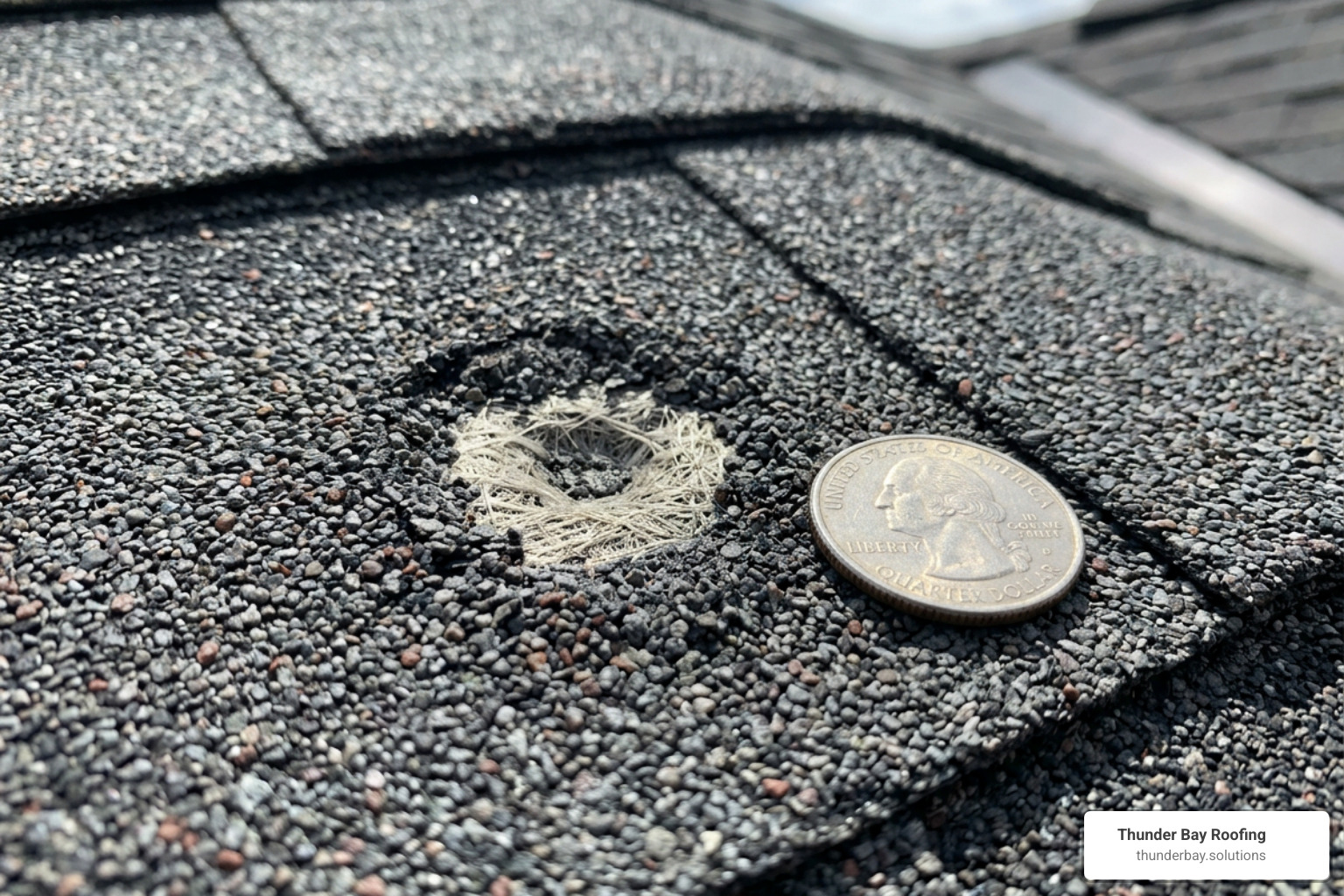
- Examine the Color of the Exposed Asphalt: Fresh hail impacts expose jet-black, unweathered asphalt. If the exposed asphalt is grey or oxidized, the granule loss is older and likely due to normal weathering.
- Check for Bruising: Gently press the center of the granule-free spot with your thumb. If it feels soft and spongy (similar to a bruised apple), the underlying fiberglass mat is fractured.
- Use a Scale Reference: Take close-up photographs of the damaged shingles using a coin, chalk circle, or inspection template to clearly show the scale of the impact.
- Document Gutter Accumulation: Photograph heavy, localized accumulations of granules at the discharge end of your downspouts immediately following the storm.
If you are unsure whether your roof has sustained functional damage, scheduling professional roof inspections is the safest way to get an honest, accurate assessment.
Frequently Asked Questions About Granule Loss and Hail
Does granule loss alone qualify as storm damage for insurance?
Generally, no. Industry standards, including the widely accepted Haag Engineering guidelines, state that granule loss without an accompanying bruise, puncture, or fracture in the shingle mat does not constitute functional damage. Because shingles naturally shed granules over time, insurance companies view simple granule displacement as cosmetic wear and tear rather than a direct physical loss, unless the underlying mat is physically compromised.
How long does a roof last after losing its protective granules?
Once the protective mineral granules are lost and the fiberglass mat is exposed, the shingle’s lifespan drops dramatically. In Florida’s hot, humid climate, exposed asphalt will soften, dry out, and crack within one to two seasons. As we look at roof lifespans from the current perspective of July 2026, a roof with widespread fiberglass exposure is highly susceptible to wind uplift and active water leaks within 12 to 24 months.
Can you repair localized granule loss without replacing the whole roof?
Yes, if the granule loss is localized to a specific area — such as where a tree branch scraped the roof or where a few isolated hailstones struck — we can perform targeted shingle replacements. However, if the granule loss is widespread across multiple slopes and the fiberglass mat is visible, spot repairs are no longer viable. In these cases, a full roof replacement is required to restore the home’s water-shedding integrity. If you have localized issues, we can help with targeted roof repair.
Conclusion
Determining whether your roof has suffered true granule loss hail damage or is simply showing its age requires a careful, scientific inspection. While finding granules in your gutters after a storm can be alarming, it doesn’t always mean your roof is ruined.
At Thunder Bay Roofing, we provide honest, expert roof evaluations throughout Wesley Chapel, Land O’ Lakes, Lutz, and the West Central Florida region. We will help you determine the exact condition of your roof and guide you through the repair or replacement process with transparency.
If you suspect your home has sustained storm damage, don’t wait for a small leak to turn into a major headache. Contact our experienced team today to schedule your professional roof inspection.