
Compare Roof Installation Costs: A Quick Start Guide to 101
2026 Roofing Material Costs and Price Benchmarks
In 2026, the national average cost to install a new roof ranges from $5,000 to $25,000 for a typical 2,000-square-foot home. The final figure is largely driven by material selection, roof geometry, and local building codes. When budgeting for a project, obtaining a detailed roof installation estimate from licensed roofing contractors ensures accurate financial planning and complete transparency on labor and material expenses.
According to 2026 national roofing cost benchmarks, material selection represents the largest single variable on any roofing proposal. A basic three-tab asphalt shingle installation sits at the lower end of the pricing spectrum, while structural standing-seam metal and concrete or clay tile systems fall on the premium end due to raw material manufacturing costs and specialized labor requirements.
| Roofing Material | Average Installed Cost (2,000 sq. ft.) | Expected Lifespan | National Resale Cost Recovery |
|---|---|---|---|
| 3-Tab Asphalt Shingles | $5,000 – $8,500 | 15 – 20 Years | 60% – 65% |
| Architectural Shingles | $7,000 – $12,000 | 25 – 30 Years | 68% |
| Standing-Seam Metal | $10,000 – $40,000 | 40 – 70 Years | 50% |
| Concrete / Clay Tile | $10,500 – $62,500 | 50 – 100 Years | 55% – 60% |
| Natural Slate | $25,000 – $65,000+ | 75 – 100+ Years | 45% – 50% |
When evaluating the financial return on investment (ROI), the 2025 Cost vs. Value report shows a national asphalt shingle roof replacement recovers approximately 68% of its cost at resale. A standing-seam metal installation recovers around 50% at resale while providing enhanced resistance against severe weather conditions.
Asphalt Shingle Pricing and Options
Asphalt shingles remain the most widely installed residential roofing product. Homeowners can select standard 3-tab shingles or upgraded architectural laminate shingles. Standard 3-tab shingles range from $3.50 to $5.50 per square foot installed, whereas dimensional architectural shingles average $4.50 to $8.50 per square foot installed.
For property owners in Wesley Chapel, FL, dimensional shingles offer critical performance advantages. They are manufactured with multiple fiberglass layers bonded together, providing an aerodynamic profile tested to resist winds up to 110 to 130 mph when fastened with a proper 6-nail pattern. Standard 3-tab shingles carry lower wind ratings (typically 60 to 70 mph) and degrade faster under intense ultraviolet (UV) radiation and recurring subtropical heat cycles.
Metal, Tile, and Premium Roofing Systems
Metal, clay, and concrete tile systems deliver long service lives in high-humidity, storm-prone regions. Standing-seam metal roofing costs between $10.00 and $20.00 per square foot installed. Because panels interlock with concealed clips and fasteners, standing-seam systems eliminate exposed screw holes, minimizing leak points during wind-driven rain events. Metal roofing also reflects solar radiant heat, lowering attic temperatures and reducing cooling demand during extended summer heat waves.
Tile systems, ranging from $11.00 to $25.00 per square foot installed, are engineered for durability. Concrete and barrel clay tiles handle high ambient temperatures and resist rot, making them popular throughout Central Florida. However, their structural weight (often exceeding 800 to 1,000 pounds per roofing square) requires an engineer or licensed roofing contractor to verify that roof trusses and load-bearing exterior walls can support the dead load before installation proceeds.
Key Factors That Shape Your Roof Installation Estimate in 2026
A comprehensive roofing estimate accounts for roof size, pitch, architectural complexity, local labor rates, and mandatory permitting fees.
Roofing contractors calculate surface dimensions using “squares,” where one roofing square equals 100 square feet of finished roof surface. A 2,000-square-foot home footprint does not equal a 20-square roof; once overhangs, eaves, gables, and pitch multipliers are factored in, that same home typically requires 22 to 26 squares of materials. Contractors apply a 10% to 15% material waste allowance to account for cuts at hips, valleys, ridges, and starter courses.
In municipal jurisdictions throughout Pasco County and Hillsborough County, estimates must account for strict Florida Building Code compliance. This includes verified wind-mitigation fastening schedules, secondary water barrier requirements, and local permit fees ($200 to $800 depending on total job value).
Pitch, Complexity, and Labor Impact on a Roof Installation Estimate
Roof pitch—the vertical rise over a 12-inch horizontal run—alters both project material requirements and labor safety protocols.
- Low Slope (under 4/12): Requires modified application techniques, such as double-layer underlayment or specialized self-adhering membranes.
- Standard Walkable Pitch (4/12 to 6/12): Serves as the industry baseline for labor calculation.
- Steep Slope (7/12 to 9/12): Adds a 15% to 25% labor surcharge due to slowed production rates and mandatory staging.
- Extreme Pitch (10/12 and above): Adds 30% to 45% to labor expenses because crews must utilize continuous safety harness rigging, roof jacks, and specialized scaffolding.
Labor accounts for roughly 60% of the total cost of a residential roof replacement. Skilled roof mechanics command hourly rates of around $130 per hour, while general laborers earn approximately $35 per hour. Architectural complexity—such as multiple dormers, intersecting valley lines, turrets, and dead-valleys—demands additional labor hours to fabricate custom flashing assemblies and ensure watertight transitions.
Critical Sub-Surface Components and Upgrades
A roof is an interconnected barrier system, not just an exterior cosmetic layer. A professional proposal itemizes each sub-surface component:
- Decking Replacement: Structural plywood or oriented strand board (OSB) serves as the nail base. Replacing damaged or rotted decking costs between $2.20 and $3.00 per square foot ($70 to $110 per 4×8 sheet installed).
- Synthetic Underlayment: Replacing obsolete organic felt, water-resistant synthetic underlayment costs $1.50 to $2.10 per square foot installed and resists tearing in high winds.
- Self-Adhering Secondary Water Barrier: Applied directly to the roof sheathing at eaves, valleys, and critical seams, this membrane seals around penetrating nail shanks to stop wind-driven rain.
- Drip Edge Flashing: Corrosion-resistant metal perimeter edging installed to guide water away from fascia boards and prevent capillary water intrusion.
- Step and Counter Flashing: Formed metal sections installed at vertical wall intersections and chimneys to keep running water out of interior framing.
- Pipe Boots and Roof Vents: Neoprene or lead penetration flashing units that seal plumbing stacks and exhaust ducts.
- Balanced Attic Ventilation: A combination of continuous ridge exhaust vents and intake soffit vents that satisfies IRC R806 standards (1 square foot of net free ventilating area per 300 square feet of attic floor space), lowering heat build-up and preventing moisture condensation.
12 Essential Line Items and Red Flags in a Roofing Quote
A professional roofing contract should provide clear visibility into all structural materials, accessories, labor allocations, and cleanup tasks.
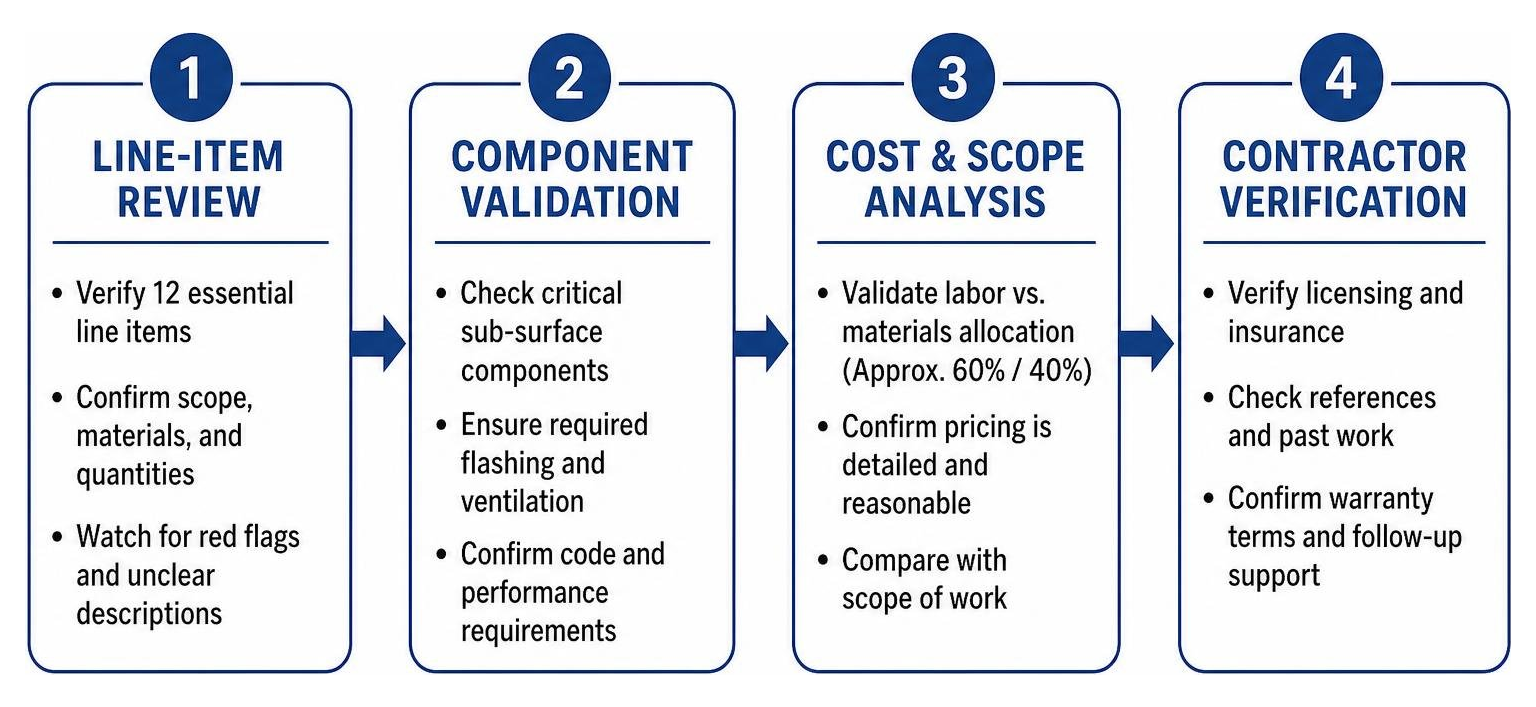
Transparent contractors outline work specifications across clear categories rather than bundling everything into a single lump sum. To evaluate a contractor’s itemization, review the standard industry breakdown outlined in How to Read a New Roof Estimate: 12 Line Items & Red Flags.
Essential Line Items in an Itemized Roof Installation Estimate
A complete, professional estimate includes these 12 distinct components:
- Tear-Off and Disposal: Labor and haul-away dumpster fees for stripping existing layers down to bare decking ($0.40 to $2.00 per square foot).
- Decking Allowance & Inspection Clause: Defined unit pricing per replacement sheet if dry rot, delamination, or termite damage is uncovered.
- Drip Edge Metal: Sizing, gauge, and color specifications for perimeter metal installed along eaves and rakes.
- Primary Underlayment: Brand name, material type (e.g., high-performance synthetic), and ASTM compliance specifications.
- Self-Adhering Membrane (Ice & Water / Peel-and-Stick): Placement zones, including valleys, flashing points, and low-slope transitions.
- Starter Shingle Strip: Dedicated manufacturer starter rolls installed along perimeter edges to lock down field shingle tabs against wind uplift.
- Field Shingles / Primary Cladding: Specific manufacturer name, product line, color, wind-warranty tier, and fastening pattern (e.g., standard 4-nail vs. enhanced 6-nail high-wind application).
- Hip and Ridge Caps: Factory-manufactured accessory units designed to match primary field shingles across hips and ridges.
- Step Flashing: New, pre-bent metal pieces installed at all roof-to-wall transitions (never reused old metal).
- Counter Flashing & Reglet Cuts: Masonry-anchored sheet metal protecting brick, stucco, or siding junctions.
- Attic Ventilation System: Total linear feet of ridge vent, off-ridge static vents, or powered attic ventilators matched to soffit intake.
- Pipe Boots, Penetrations, and Flashing Collars: Heavy-duty boots sealing plumbing vent stacks and exhaust conduits.
How to Spot Red Flags and Avoid Storm Chasers
Unscrupulous operators and transient “storm chasers” frequently exploit severe weather events to secure rushed roofing contracts. Homeowners should watch for these critical warning signs:
- Unitemized Single-Lump-Sum Proposals: A quote that reads simply “Replace roof – $14,000” conceals whether the contractor intends to reuse rusted flashing, apply cheap underlayment, or omit starter shingles.
- Missing Manufacturer Specifications: Failure to name the brand, product line, and warranty grade leaves the door open to sub-par product substitutions on delivery day.
- Vague Decking Clauses: Bids that lack a clear per-sheet replacement rate expose homeowners to inflated change-order fees once the old roof is stripped.
- Bids Greater Than 20% Below Market: Substantially discounted bids often signal missing workers’ compensation coverage, unlicensed labor, omitted building permits, or the use of non-matching factory-second materials.
- High-Pressure “Today-Only” Discounts: Demand for an immediate contract signature, or requests to hand over an entire insurance claim check upfront, indicate high-risk contractor operations. Always verify active state licensing, municipal registrations, and active general liability insurance before executing a roofing agreement.
New Construction vs. Re-Roofing and Tear-Off Fees
New construction roofing differs significantly from re-roofing an existing structure in both labor allocation and site preparation.
In new construction, roof mechanics fasten underlayment and primary cladding directly over newly installed, clean plywood decks. There are no demolition phases, old nails to pull, or deteriorated substrates to navigate, streamlining crew production timelines.
Re-roofing an existing structure requires substantial demolition labor. Removing and disposing of old roofing materials costs between $0.40 and $2.00 per square foot ($40 to $200 per square), depending on roof steepness, height, and accessibility.
If previous owners installed a second layer of shingles over an initial layer (an “overlay”), disposal costs double because crews must strip and haul twice the material weight. Installing new shingles over old layers hides decking decay, traps excess attic heat, and can void manufacturer wind and material warranties. Professional contractors perform a complete tear-off to expose the structural deck, allowing for nail re-fastening and substrate repairs prior to installing new weatherproofing layers. Homeowners evaluating full replacement workflows can review our approach to residential roof replacement.
Roof Repair vs. Full Roof Replacement
Deciding whether to perform localized repairs or execute a total roof replacement depends on the structure’s age, overall surface degradation, and the physical extent of the damage.
Minor roof repairs nationwide average between $400 and $2,000 for isolated issues, such as replacing a broken pipe boot, resealing counter flashing, or resetting a small section of wind-lifted shingles.
A full replacement becomes necessary when:
- The Roof Exceeds 75% Life Expectancy: Asphalt shingles past 15 to 20 years old lose volatile asphalt compounds, shedding protective mineral granules and turning brittle.
- Damage Exceeds the 25% Threshold: Under building codes across Florida, if more than 25% of a roof section is damaged within a 12-month window, the entire roof system must be brought up to current building code standards.
- Widespread Structural Sheathing Decay: Chronic leaks that cause widespread decking sag or rafter rot require a full tear-off to rebuild the underlying structural system.
- Repair Costs Exceed 30% of Total Replacement Value: When localized repair quotes exceed roughly one-third of the cost of a full replacement, investing in a complete new roof system provides superior long-term financial value and warranty coverage.
To avoid premature replacements and pinpoint active failure points, schedule comprehensive roof inspections to evaluate your roof’s condition.
Frequently Asked Questions About Roofing Costs
What is the average cost to install a new roof in 2026?
For a standard 2,000-square-foot home, a new roof installation in 2026 typically costs between $9,000 and $16,500 for dimensional architectural asphalt shingles.
Standing-seam metal systems range from $20,000 to $40,000, while concrete and clay tile installations run from $22,000 to $50,000. Labor accounts for roughly 60% of these total figures, with material, permitting, waste, and disposal accounting for the remaining 40%.
Why do roof estimates vary so drastically between contractors?
Discrepancies between roofing quotes generally stem from differences in the scope of work, material grades, labor classifications, and company overhead.
A lower bid may omit a complete tear-off, reuse damaged step flashing, skip starter strips, use lower-grade three-tab shingles, or lack proper workers’ compensation insurance. Higher-tier proposals usually reflect certified master-contractor installations, 6-nail high-wind fastening methods, premium synthetic underlayments, secondary water barrier applications, and comprehensive 10- to 25-year non-prorated workmanship warranties.
Does insurance cover a roof installation or replacement?
Homeowners insurance covers roof replacement when damage results from sudden, accidental perils, such as windstorms, hail, or falling trees. Policies exclude coverage for gradual wear and tear, age-related deterioration, or deferred maintenance.
When filing a claim, coverage depends on policy terms:
- Replacement Cost Value (RCV): Covers the cost to replace the damaged roof at current market labor and material prices, minus the deductible.
- Actual Cash Value (ACV): Depreciates the payout based on the roof’s age, paying only the remaining depreciated value.
Conclusion
Understanding the variables that influence a roof installation estimate allows homeowners to protect their homes while securing lasting value. Evaluating roofing proposals based on itemized scopes, verified material specifications, code-compliant ventilation, and certified contractor credentials prevents unexpected costs and ensures long-term roof performance.
Homeowners in Wesley Chapel, FL, Lutz, FL, Land O’ Lakes, FL, and Oldsmar, FL can rely on Thunder Bay Roofing for transparent, detailed, and code-compliant roofing solutions built to withstand extreme Florida weather. Contact our experienced team to schedule an on-site property inspection and secure your written, itemized free roof quote today.