
How to Fix Ponding Water on a Flat Roof in 5 Easy-to-Follow Steps in Chicago
Understanding Standing Water on Low-Slope Roofs
To fix flat roof ponding on Florida low-slope roofs, professional roofing contractors clear blocked drainage outlets, rebuild positive slope toward drains using lightweight leveling compounds or tapered polyisocyanurate insulation, and seal the repaired area with seamless waterproof coatings. Professional flat roof ponding repair stops water accumulation before Florida’s daily afternoon storms and wind-driven rain cause severe structural damage. If your commercial or residential low-slope roof retains water in Wesley Chapel, Lutz, Land O Lakes, or Oldsmar, scheduling a professional low-slope roof inspection with Thunder Bay Roofing ensures an accurate drainage assessment.
While low-slope roofing systems are engineered to manage water runoff, they are never completely horizontal. Industry standards require a continuous positive slope toward drains, scuppers, or gutters.
The National Roofing Contractors Association (NRCA) establishes the 48-hour benchmark for flat roof drainage. Any water remaining on a low-slope roof membrane 48 hours after rainfall ceases under drying conditions is classified as ponding. Standing water past this window accelerates membrane breakdown by 50 to 70 percent based on NRCA studies.
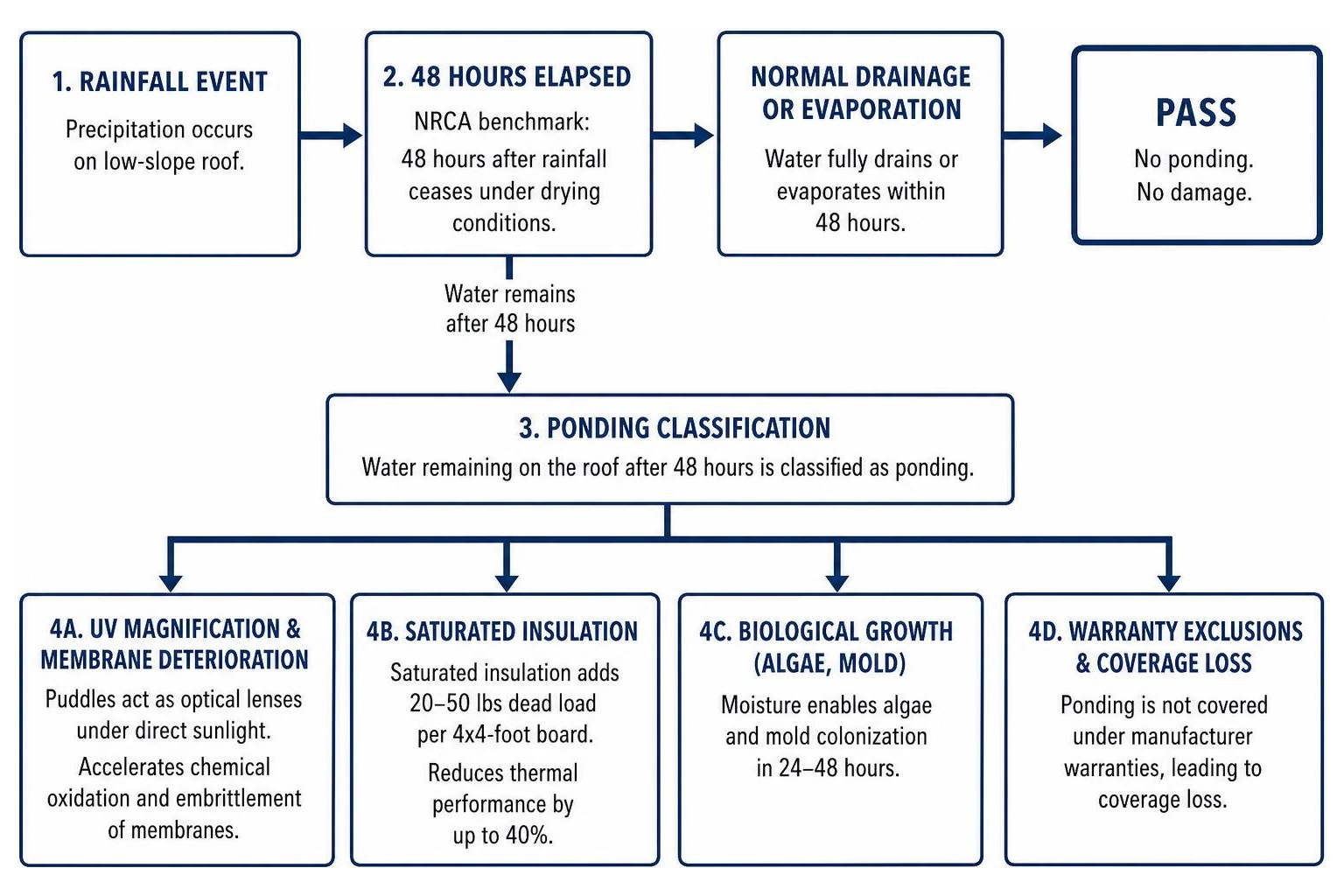
Ponding creates compounding structural and physical stress across the entire roof assembly:
- Structural Deflection: Water weighs 5.2 pounds per square foot per inch of depth. Accumulated water exerts dead load stress on decking and joists, causing the roof deck to sag further and create a deeper depression that holds even more water.
- Insulation Compression: Chronic standing water compresses underlying polyisocyanurate (polyiso) insulation boards. Saturated insulation adds 20 to 50 pounds of dead load per 4×4-foot board while reducing thermal performance by up to 40 percent.
- UV Magnification: Puddles act as optical lenses under direct sunlight. Standing water magnifies Florida’s intense UV radiation, accelerating the chemical oxidation and embrittlement of single-ply membranes and asphalt bitumen.
- Biological Growth: Mold spores colonize wet substrates within 24 to 48 hours of sustained moisture exposure according to the EPA. Algae, moss, and vegetation trap silt and root into surface seams.
As outlined in NRCA ponding guidelines and analysis, standing water voids warranty coverage on essentially every major single-ply system, including assemblies manufactured by GAF, Carlisle, Holcim/Firestone, Sika Sarnafil, and Versico. Furthermore, commercial property insurance carriers frequently classify interior leaks resulting from unaddressed ponding water as preventable maintenance neglect, which can lead to denied claims and increased renewal premiums.
5-Step Process for Flat Roof Ponding Repair
Flat roof ponding repair requires a licensed roofing crew to identify the root cause of water accumulation, confirm structural stability, and restore positive drainage toward functional roof outlets. The following five stages describe the professional evaluation and repair workflow property owners should expect, not a homeowner DIY procedure.
Commercial and residential low-slope roofs should not be walked, opened, coated, or altered without proper fall protection and roof-system knowledge. Professional crews follow OSHA requirements for fall arrest harnesses, warning lines, and toe boards, especially because ladder falls cause over 500,000 injuries annually in the United States according to the CDC.
Step 1: Mapping Low Spots and Drainage Deflections
The initial stage of drainage remediation is professional documentation of where water remains after a storm:
- Chalk-Line Mapping: Technicians inspect the roof surface 48 hours after precipitation ends and mark the perimeter of remaining ponding areas.
- Depth Measurement: A straightedge and digital level are used to document the maximum depth of the water basin.
- Residue Tracking: On dry days, inspectors identify chronic ponding areas by locating dark mineral deposit rings, accumulated silt, and biological algae staining.
- Flow Path Verification: Technicians evaluate the path of water runoff to determine whether physical barriers, such as unsloped HVAC curbs or conduit lines, are obstructing the route to roof outlets.
Step 2: Clearing and Modifying Roof Drainage Outlets
Drainage outlets must function at design capacity before membrane low spots can be corrected:
- Internal Drain Clearing: Technicians remove debris, silt, and obstructions from drain bowls and strainers to re-establish water flow.
- Scupper Maintenance: Parapet scuppers are cleared of foreign matter, and flashing seals around through-wall openings are checked for water tightness.
- Secondary Drainage Compliance: In accordance with IPC 1106 plumbing requirements, secondary emergency overflow drains or scuppers must be positioned at least 2 inches above the primary drain inlet to prevent catastrophic roof loading during severe downpours.
- Leak Path Assessment: Technicians perform roof leak detection around drain bowls and clamping rings to verify that water is not escaping into the roof deck.
Step 3: Inspecting Membrane Integrity and Substrate Firmness
Applying repair materials over compromised insulation causes rapid patch failure, so substrate condition must be verified first:
- Substrate Probing: The membrane within and surrounding the ponding perimeter is probed. Spongy, yielding decking indicates saturated sub-membrane insulation.
- Core Sampling: A certified technician takes core cuts through the membrane assembly when moisture is suspected, checking whether the polyiso insulation core is wet. Saturated insulation boards must be removed and replaced.
- Flashing and Seam Review: Seams are mechanically probed. Because 80 to 90 percent of flat roof leaks originate at flashing details and transitions, all penetrations and edge flashings near the ponding zone are checked for delamination across modern flat roof systems.
Step 4: Applying Leveling Compounds for Flat Roof Ponding Repair
Localized depressions up to 1 inch deep on structurally sound substrates may be corrected by a roofing contractor using commercial roof leveling compounds:
- Material Selection: Professional contractors utilize lightweight compounds made of polyurethane binders combined with recycled EPDM granules and expanded polystyrene (EPS) beads. These lightweight mixtures weigh roughly one-fifth the weight of concrete mortars and half the weight of the water they displace.
- Surface Preparation: The repair zone is cleaned, dried, and primed according to the membrane and compound manufacturer’s requirements so the new material bonds properly.
- Positive Slope Formation: As detailed in the Technical Guide for 570 Slope Compound, the finished repair must create positive slope toward the drainage outlet rather than form a raised obstruction that traps water elsewhere.
- Curing Review: The applied leveling compound is allowed to cure based on ambient temperature, humidity, and application thickness before any topcoat or water test is performed.
Step 5: Sealing with Waterproof Topcoats and Controlled Testing
Once the slope correction has cured, the repaired area must be encapsulated and verified by the roofing crew:
- Topcoat Encapsulation: A compatible protective coating, such as high-solids silicone or elastomeric acrylic, is applied across the cured repair and tied into the existing membrane system.
- Controlled Flow Test: After the topcoat cures completely, technicians conduct a controlled water test to confirm that water sheets smoothly toward the drain without retention.
- Scheduled Monitoring: The property owner receives documentation establishing a semi-annual inspection schedule to clear drain strainers and monitor coating condition.
Permanent Drainage Restoration: Tapered Insulation, Crickets, and Coatings
When localized leveling compounds are insufficient for broad roof deflections, commercial properties require engineered drainage solutions.
| Drainage Restoration Method | Best Use Case | Typical Lifespan | Primary Advantage |
|---|---|---|---|
| Tapered Polyiso Insulation | Full roof re-sloping & structural sag | 25–30 Years | Permanent fix; adds R-value insulation |
| Roof Crickets & Saddles | Water trapped behind HVAC curbs | 20–25 Years | Diverts flow around rooftop obstructions |
| Drain Additions / Sumps | Inadequate drainage capacity | 25+ Years | Relieves localized volume bottlenecks |
| Lightweight Leveling Kits | Isolated shallow dips (<1" deep) | 5–10 Years | Rapid installation; minimal dead load |
| Silicone Roof Coatings | Sound roofs with minor water retention | 10–15 Years | Tolerates continuous standing water |
Property managers managing large facilities often combine these methods during a planned commercial roof repair program to ensure compliance with Florida hurricane season wind uplift standards and Pasco and Hillsborough County permit and wind-mitigation requirements.
Tapered Polyiso Systems vs. Drain Additions
Tapered polyisocyanurate (polyiso) insulation systems serve as the industry standard for permanent slope correction. International Building Code (IBC 1507) mandates a minimum design slope of 1/4 inch per foot for positive drainage on new low-slope roof assemblies.
- Tapered Polyiso Boards: Factory-tapered panels are installed directly over the structural deck beneath the waterproofing membrane, creating a consistent slope that directs water toward drains. This method permanently removes low spots while increasing thermal insulation values by R-6 to R-20.
- Roof Crickets: Triangular or diamond-shaped tapered crickets are installed upstream of rooftop air conditioning units, skylight curbs, and parapet walls. Crickets channel moving water around wide obstacles, preventing stagnation behind mechanical curbs.
- Through-Deck Drain Additions: Adding an internal through-deck drain involves core-drilling the concrete or steel decking, installing a cast-iron or aluminum drain bowl with clamping rings, building a recessed sump area, and tying the unit into the building’s internal plumbing lines.
The Role of Silicone Coatings in Standing Water Management
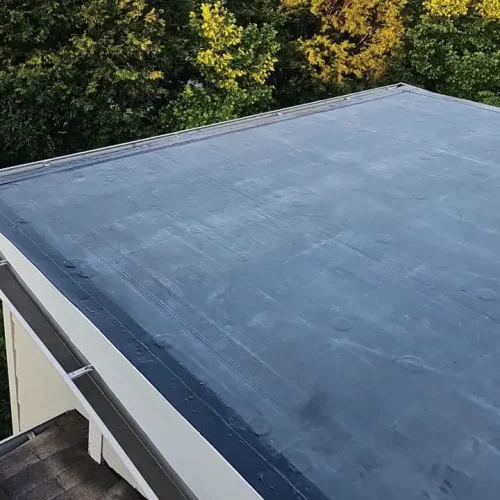
Silicone coatings provide unique chemical advantages for low-slope roofs where minor ponding cannot be completely eliminated through framing alterations:
- Chemical Inertness: Unlike water-based acrylic coatings that re-emulsify and soften when submerged, high-solids silicone coatings are moisture-cured and chemically inert. They maintain their physical strength, elasticity, and adhesion under continuous ponding water.
- Ponding Warranties: Silicone is the only coating chemistry backed by major manufacturers with explicit 10- to 15-year ponding water warranty coverage.
- Recoat Constraints: Silicone surfaces are non-stick once cured. Nothing adheres to silicone except fresh silicone, meaning future repairs or recoats must continue using compatible silicone formulations.
Membrane Performance and Financial Impact of Standing Water
Ignoring ponding water leads to severe structural and financial consequences. Early identification during comprehensive roof inspections prevents localized moisture problems from turning into full structural failures.
Cost Breakdown of Flat Roof Ponding Repair Options
Repair costs vary based on the physical size of the low spot, the condition of the substrate, and the repair method selected:
- Retail Patch Materials for Very Small Areas: $20 to $200 for basic granular filler and polyurethane binder kits. These materials do not replace a professional drainage assessment and are not appropriate for roofs with leaks, saturated insulation, structural sagging, or warranty coverage.
- Professional Drain Clearing: $75 to $150 to clear clogged internal drain bowls, strainers, and scuppers.
- Professional Localized Patching and Leveling: $300 to $750 for compound leveling, membrane patching, and coating tie-ins.
- Drain Addition / Sump Installation: $1,500 to $4,000 per drain assembly, including internal plumbing integration and flashing tie-in.
- Roof Cricket Construction: $400 to $1,500 per unit behind rooftop equipment curbs or parapet transitions.
- Tapered Polyiso Insulation Retrofit: $2.50 to $5.50 per square foot installed as part of a recovered assembly.
- Full Roof Tear-Off and Replacement: $8.00 to $16.00 per square foot when structural decking and insulation are extensively rotted.
Membrane Comparison: TPO vs. EPDM Water Tolerance
Single-ply roofing membranes exhibit distinct material behaviors when exposed to continuous moisture:
- Thermoplastic Polyolefin (TPO): TPO relies on hot-air welded seams. When exposed to persistent ponding, water magnifies solar radiation and accelerates the loss of chemical plasticizers, causing surface micro-cracking and seam delamination. Under chronic ponding, a TPO membrane’s expected lifespan drops from 20-30 years down to 10-15 years, a 30 to 50 percent reduction.
- Ethylene Propylene Diene Monomer (EPDM): EPDM synthetic rubber demonstrates higher natural tolerance to standing water due to its thermoset molecular structure. However, chronic standing water degrades adhesive-glued seam tapes over time. An EPDM system with unaddressed ponding sees its service life decline from 25-30 years down to 15-20 years, a 15 to 25 percent reduction.
Frequently Asked Questions About Flat Roof Drainage
What is the NRCA 48-hour rule for flat roof ponding?
The National Roofing Contractors Association (NRCA) defines roof ponding as any water that remains standing on a low-slope roof 48 hours after rainfall ceases under dry, sunny conditions. Water lingering past this 48-hour window indicates insufficient drainage or structural deflection and accelerates membrane degradation.
Does ponding water void manufacturer roof warranties?
Yes. Standard commercial and residential flat roof warranties from major manufacturers like GAF, Carlisle, Holcim, and Sika exclude damage caused by ponding water. Standing water that persists past 48 hours voids warranty claims regarding seam separation, leaks, and accelerated material degradation unless a specific ponding waiver rider was purchased during original installation.
Can roof coatings permanently eliminate ponding water?
No. Roof coatings do not correct the physical slope of a roof deck or remove the low spot that collects water. While silicone coatings tolerate continuous standing water without breaking down, they do not resolve underlying drainage issues, dead-load stress, or structural deflection. Permanent elimination of ponding requires tapered insulation, crickets, leveling compounds, or drain additions.
Conclusion
Resolving flat roof ponding is essential for preserving the structural integrity and service life of low-slope buildings in Florida’s storm-prone climate. A professional repair process starts with mapping low areas, clearing drainage lines, evaluating substrate soundness, selecting the correct slope-restoration method, and sealing the surface with compatible waterproof coatings.
When standing water covers large areas or stems from structural deck sagging, permanent solutions like tapered polyiso insulation and secondary overflow drains are required. For property owners across Wesley Chapel FL, Lutz FL, Land O Lakes FL, and Oldsmar FL, the licensed professionals at Thunder Bay Roofing provide complete commercial and residential low-slope solutions built for daily afternoon storms, intense UV exposure, wind-driven rain, and Florida hurricane season wind uplift requirements.
Schedule an evaluation with our team for your next roof repair to restore positive drainage and protect your investment against extreme weather.