
What to Do When Mother Nature Attacks Your Roof in Wesley Chapel
When Storms Strike: What Wesley Chapel Roof Owners Need to Know First
Storm damage roof in Wesley Chapel is one of the most urgent — and most misunderstood — problems a Florida property owner can face. Pasco County’s severe weather season brings hail, high winds, and torrential rain that can silently compromise a roof long before a single drop appears on your ceiling.
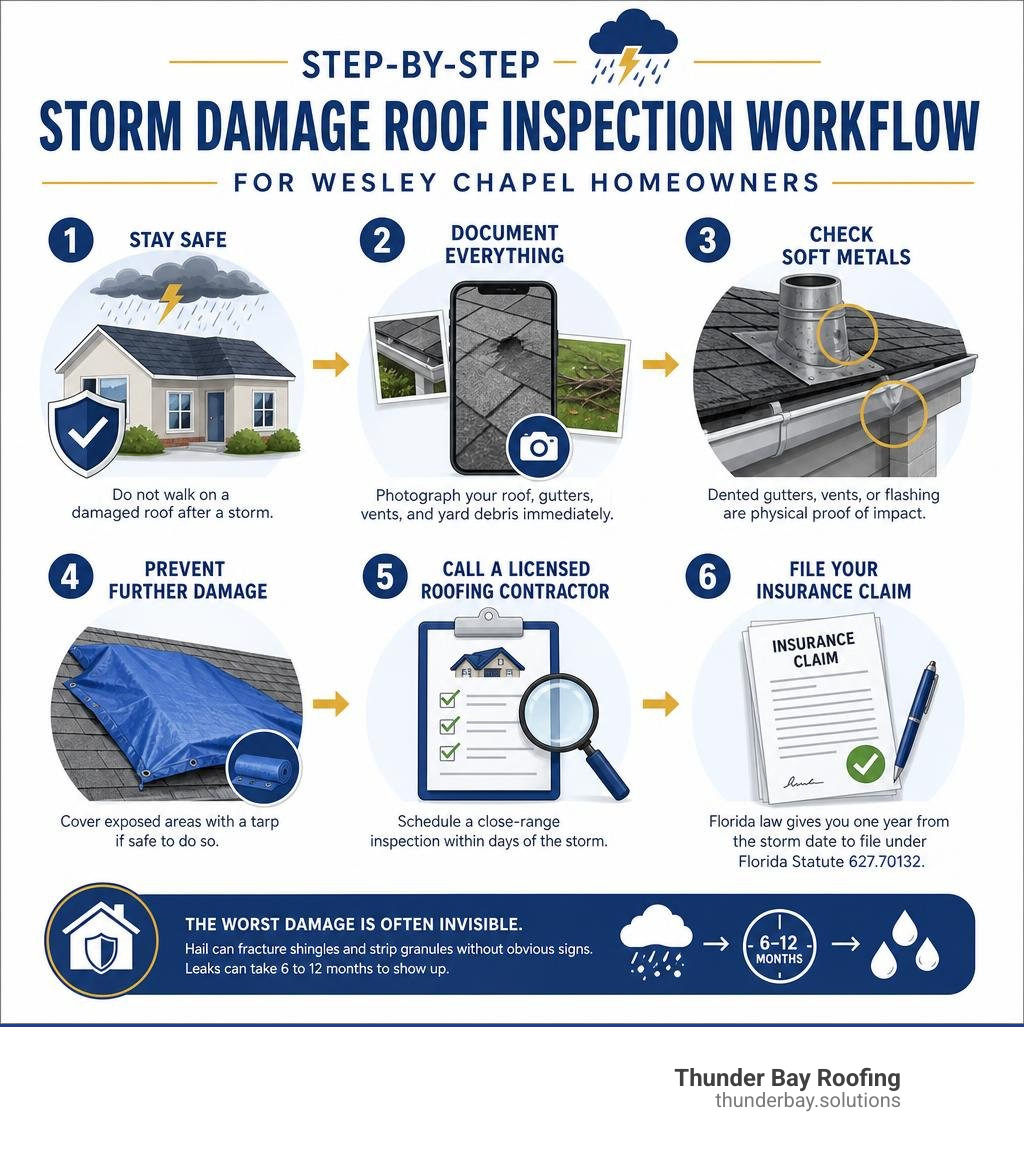
Here’s what to do right now if your roof was just hit by a storm:
- Stay safe — do not walk on a damaged roof after a storm
- Document everything — photograph your roof, gutters, vents, and yard debris immediately
- Check soft metals — dented gutters, vents, or flashing are physical proof of impact
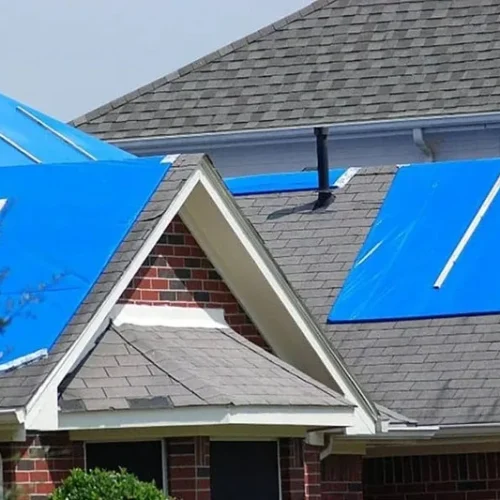
- Prevent further damage — cover exposed areas with a tarp if safe to do so
- Call a licensed roofing contractor — schedule a close-range inspection within days of the storm
- File your insurance claim — Florida law gives you one year from the storm date to file under Florida Statute 627.70132
The tricky part? The worst damage is usually invisible. Hailstones can fracture the fiberglass mat inside your shingles and strip protective granules without leaving a single obvious hole. Roofers in the industry call hail the “silent killer” — because leaks from an uninspected storm hit typically take 6 to 12 months to show up inside your home. By then, structural rot has often already begun.
Consider what happens on streets like Bruce B. Downs Blvd or in neighborhoods like Seven Oaks after a localized Pasco County hailstorm: roofs look perfectly fine from the street, homeowners assume everything is okay, and then — months later — ceiling stains and mold appear. The storm caused the damage. Time and Florida’s brutal UV rays finished the job.
That’s exactly why acting fast matters. Thunder Bay Roofing provides professional storm damage inspections and repairs built specifically for Wesley Chapel’s weather reality.
I’m Tyler Wood, owner of Thunder Bay Home Solutions and Thunder Bay Roofing in Wesley Chapel — and through years of operating in the Tampa Bay area, I’ve seen how storm damage roof claims in Wesley Chapel are lost not because the damage wasn’t real, but because it wasn’t properly documented in time. This guide will walk you through everything you need to protect your property and your claim.
Types of Weather Impacts and Hail Size Thresholds
In West Central Florida, Mother Nature serves up a potent combination of extreme weather events. While most homeowners associate severe roof destruction with severe tropical storms or full-scale hurricanes, localized severe thunderstorms frequently inflict catastrophic force on residential and commercial structures across Pasco County. Understanding how wind, hail, and torrential rain interact with your roofing assembly is the first step toward safeguarding your investment.
When a storm rolls through Wesley Chapel, Land O’ Lakes, or Lutz, your roof faces three distinct forces:
- Wind Uplift Force: High-velocity winds create pressure differentials across your roof deck. Wind lifts shingle edges, breaks factory sealant strips, tears off ridge caps, and creates entry points for driving rain. When severe wind forces lift shingles, we frequently recommend specialized wind damage repair to replace torn tabs and re-seal compromised sections.
- Water Intrusion: Driven by tropical gusts, rainfall travels horizontally and upward beneath lifted shingles, compromised flashing, and compromised underlayment.
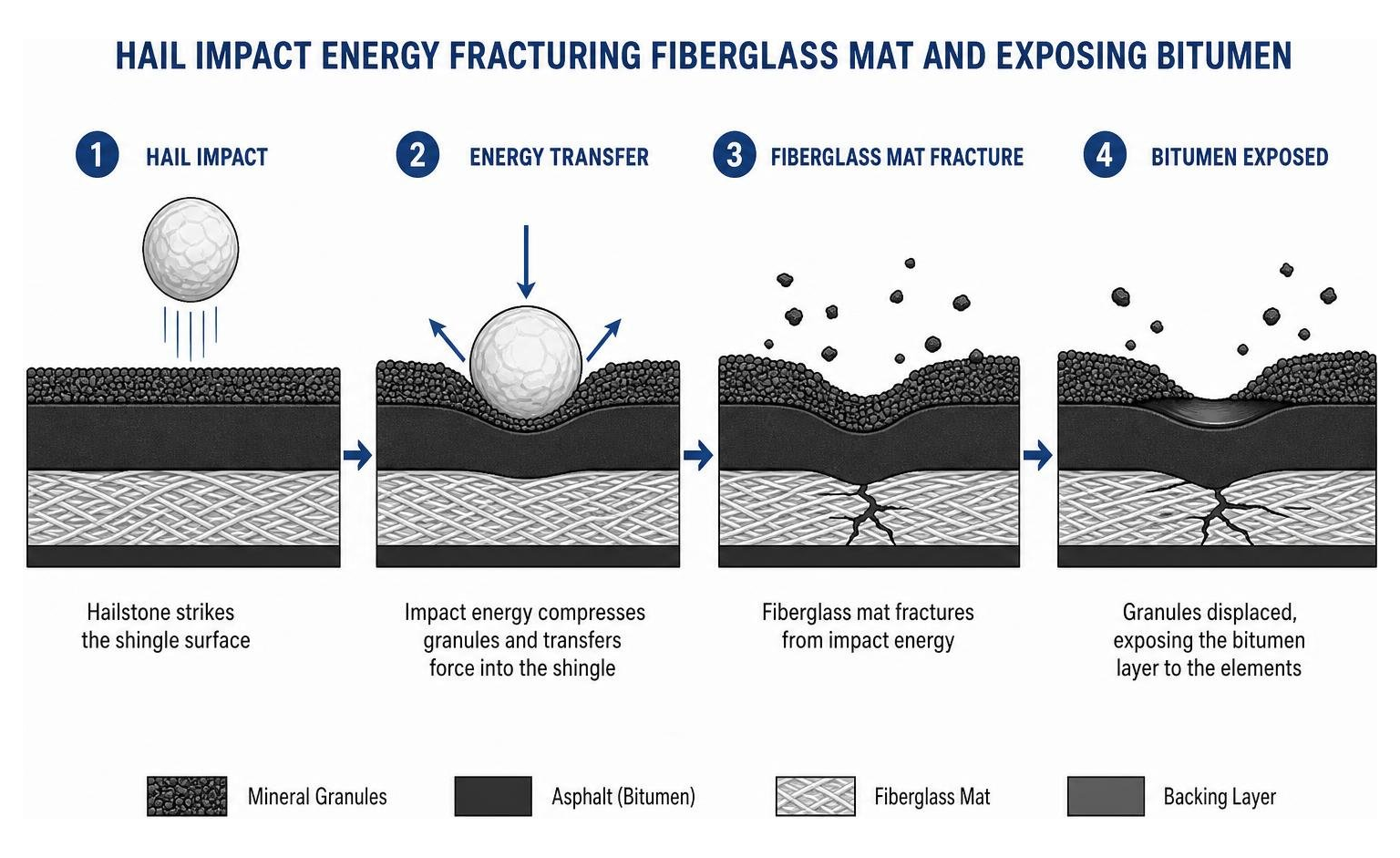
- Impact Displacement (Hail): Hailstones strike roofing materials at terminal velocities ranging from 20 to over 90 miles per hour, transferring kinetic energy directly into the roofing substrate.
Identifying Hidden Storm Damage Roof Wesley Chapel Homeowners Face
Hail damage is fundamentally different from wind damage. Wind tears materials away in a visually obvious fashion; hail inflicts deep mechanical shock on structural layers while leaving the exterior surface deceptively intact.
When a hailstone strikes an asphalt shingle, it compresses the mineral granule surfacing into the underlying asphalt (bitumen) coating. This impact causes two critical, hidden failures:
- Granule Loss and Bitumen Exposure: Granules protect asphalt from ultraviolet radiation. When hail dislodges these granules, it leaves raw bitumen exposed. Over the next 6 to 12 months, Florida’s intense sunshine bakes this raw asphalt, causing it to dry out, crack, and shrink.
- Fiberglass Mat Fracturing (“Bruising”): The primary strength of a modern architectural shingle comes from its woven fiberglass core mat. Hail impacts break these delicate glass fibers beneath the asphalt coating. While the top layer may look fine to an untrained eye from the ground, pressing firmly on the impact spot reveals a soft spot or “bruise” where the structural reinforcement has completely failed.
Because granules wash down into downspouts, homeowners in communities like Seven Oaks or Meadow Pointe often discover piles of black sediment at their downspout exits days after a storm. This granule loss combined with hidden fiberglass mat fractures inevitably allows rain to seep into the roof decking, rotting structural trusses and causing interior drywall failure months down the road. For comprehensive guidance on spotting these initial signs, explore our Blog: The Ultimate Storm Damage Repair Checklist. When immediate remediation is needed, our expert team provides dedicated storm damaged roofing support.
Hail Size Impact Matrix: Asphalt Shingles vs. Commercial TPO and EPDM Membranes
The physical impact of a hailstorm correlates directly to the physical mass and diameter of the falling ice. Hailstones range from minor ice pellets to massive, dense spheres capable of punching clean holes through solid plywood decks.
In Wesley Chapel and surrounding West Central Florida regions, the technical impact of varying hail sizes breaks down as follows:
| Hail Diameter | Physical Analogy | Impact Potential on Asphalt Shingles | Impact Potential on Commercial Membranes (TPO / EPDM) |
|---|---|---|---|
| 0.75 Inches | Penny / Dime | Minor granule dislodgement, seal tab stress, subtle pockmarks on aluminum downspouts. | Negligible impact on reinforced TPO or elastomeric EPDM membranes. |
| 1.25 – 1.50 Inches | Half Dollar | Moderate granule loss, distinct shingle bruising, localized mat cracking, soft metal denting. | Early TPO surface micro-fracturing over rigid ISO board substrates; minor surface scuffing on EPDM. |
| 1.75 Inches | Golf Ball | Severe shingle bruising, structural fiberglass mat fractures, flashing displacement, vent destruction. | Punctures in aged single-ply membranes, insulation crushing beneath TPO weld seams. |
| 2.00 Inches | Egg | Direct shingle punctures, shattered clay/concrete tiles, widespread underlayment tears. | Star-shaped micro-fractures in TPO; membrane punctures over mechanical fasteners. |
| 2.50+ Inches | Baseball / Larger | Catastrophic structural penetration, fractured roof sheathing, complete roof envelope failure. | Widespread structural punctures, destroyed skylights, compressed insulation layers across flat decks. |
Commercial flat roofing systems respond uniquely to impact forces. Thermoplastic Polyolefin (TPO) roofs are rigid membranes stretched over polyisocyanurate (ISO) insulation boards. When hail strikes a TPO membrane, it creates subtle, star-shaped micro-fractures on the underside of the sheet. Water penetrates these fractures and saturates the insulation beneath long before surface water becomes visible inside the facility.
Conversely, Ethylene Propylene Diene Monomer (EPDM) synthetic rubber is highly flexible and absorbs impact energy better than TPO. However, when hail strikes EPDM installed over unyielding substrates or rigid coverboards, the membrane can pin-hole, allowing hidden moisture to enter the building envelope. To evaluate commercial or flat membrane structures affected by severe atmospheric events, view our specialized flat roof systems solutions.
Navigating Legal Frameworks for Storm Damage Roof Wesley Chapel Claims
Filing a roof damage insurance claim in Pasco County requires a clear understanding of Florida’s statutory laws and building standards. Florida operates under strict building codes and insurance regulations designed to protect property owners, but navigating these laws without professional guidance can leave you vulnerable to underpaid claims or outright coverage denials.
The Florida 25% Rule and Matching Statute Requirements
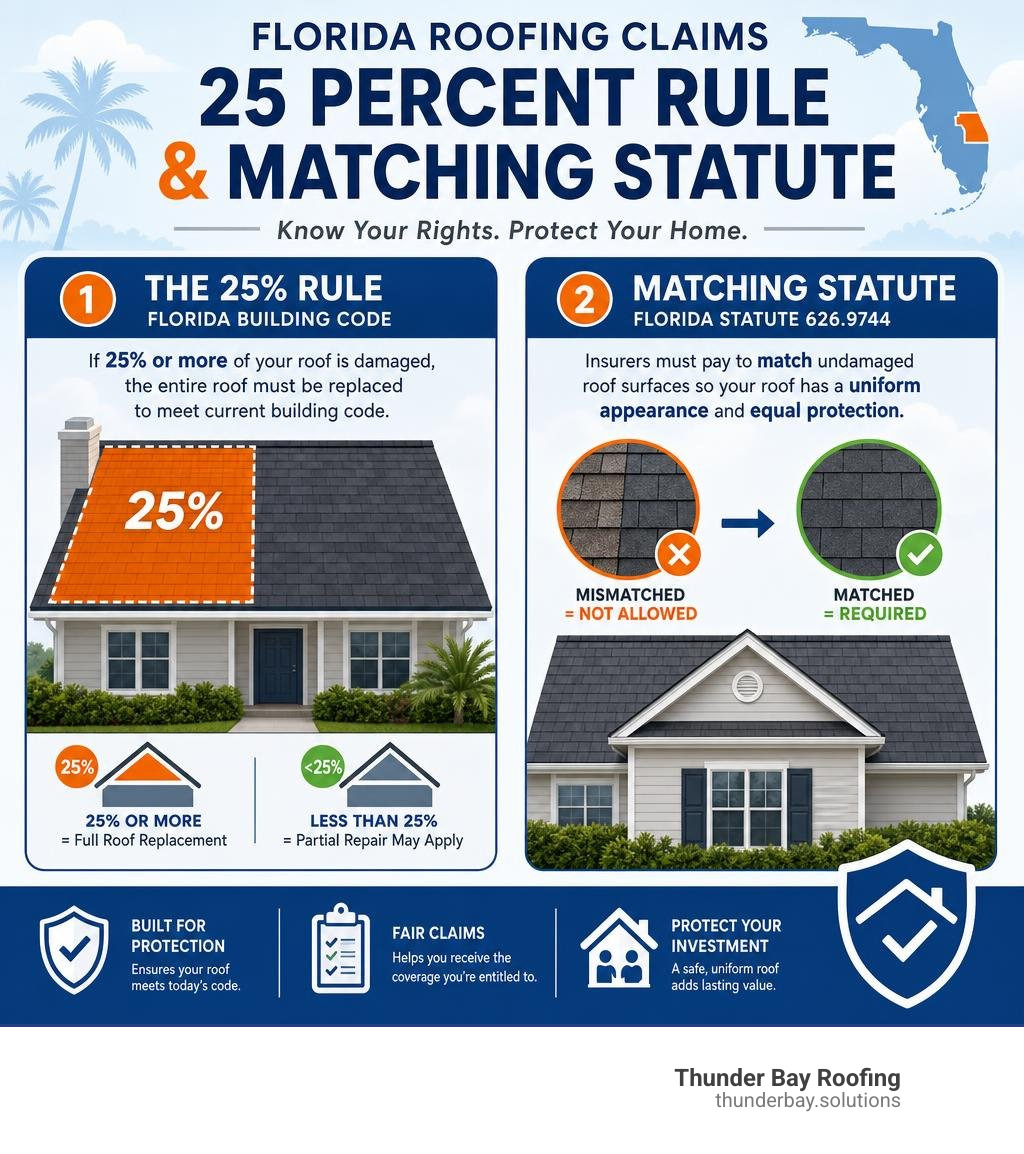
Two vital state statutes dictate how insurance companies must handle partial roof damage across West Central Florida:
1. The Florida 25% Rule (Florida Building Code)
The Florida Building Code contains a mandatory provision regarding roof repairs: if more than 25% of a total roof section or module is repaired, damaged, or replaced within any 12-month period, the entire roof section must be brought into full compliance with the latest Florida Building Code.
In practical terms, if severe wind or hail impacts 30% of a roof slope on your Wesley Chapel home, your insurance carrier cannot simply pay to patch that localized section. Under state law, the entire roof section must be fully replaced to ensure structural integrity and code adherence. When local code mandates a complete system installation rather than a spot patch, property owners rely on our comprehensive roof replacement services.
2. The Florida Matching Statute (Section 626.9744)
Under Florida Statute Section 626.9744, when an insurance policy pays for the replacement of damaged materials, the insurer must provide materials that match the original in quality, color, and size.
Shingle manufacturers frequently alter batch colors, discontinue specific product lines, or re-engineer granule blends every few years. If hail damages 15% of your roof, but the existing asphalt shingle has been discontinued by the manufacturer, an exact match is impossible. Patching the roof with non-matching shingles creates a mismatched appearance that depreciates your home’s resale value. Under Section 626.9744, if a reasonable match cannot be obtained, the insurance carrier is legally obligated to replace the adjacent undamaged roof sections to ensure a uniform appearance.
Cosmetic vs. Functional Damage Under Florida Insurance Law
Insurance adjusters frequently inspect storm-damaged properties in Wesley Chapel and attempt to deny claims by classifying hail impacts as “merely cosmetic.” Understanding the distinction between cosmetic wear and functional damage under Florida law is vital for every property owner.
- Cosmetic Damage: Superficial alterations that affect only the aesthetic appearance of the roof without altering its operational performance, water-shedding capacity, or structural lifespan.
- Functional Damage: Physical alteration to roofing materials that reduces the system’s water-shedding capability, compromises structural integrity, fractures core components, or prematurely shortens the remaining useful service life of the roof.
Industry leaders like Owens Corning Technical Guidelines establish that granule loss exposing underlying bitumen and fiberglass mat fracture directly shorten a shingle’s functional service life. Under Florida insurance policy standards, any storm-induced impact that accelerates wear or causes micro-fractures constitutes functional damage. When an insurer attempts to reclassify functional hail impacts as normal cosmetic wear, professional forensic inspection data is required to prove that the roof’s water-shedding system has been legally and physically compromised.
Immediate Emergency Actions and Insurance Claim Navigation
When Mother Nature attacks your roof, taking immediate, systematic action preserves both the physical safety of your home and your financial protection under your insurance policy.
Emergency Mitigation and Moisture Prevention
Your insurance policy explicitly requires you to take reasonable steps to mitigate secondary damage after a storm event. Allowing rain to pour through compromised shingles into your ceiling framing without intervention can give insurance carriers grounds to deny the interior portion of your property claim.
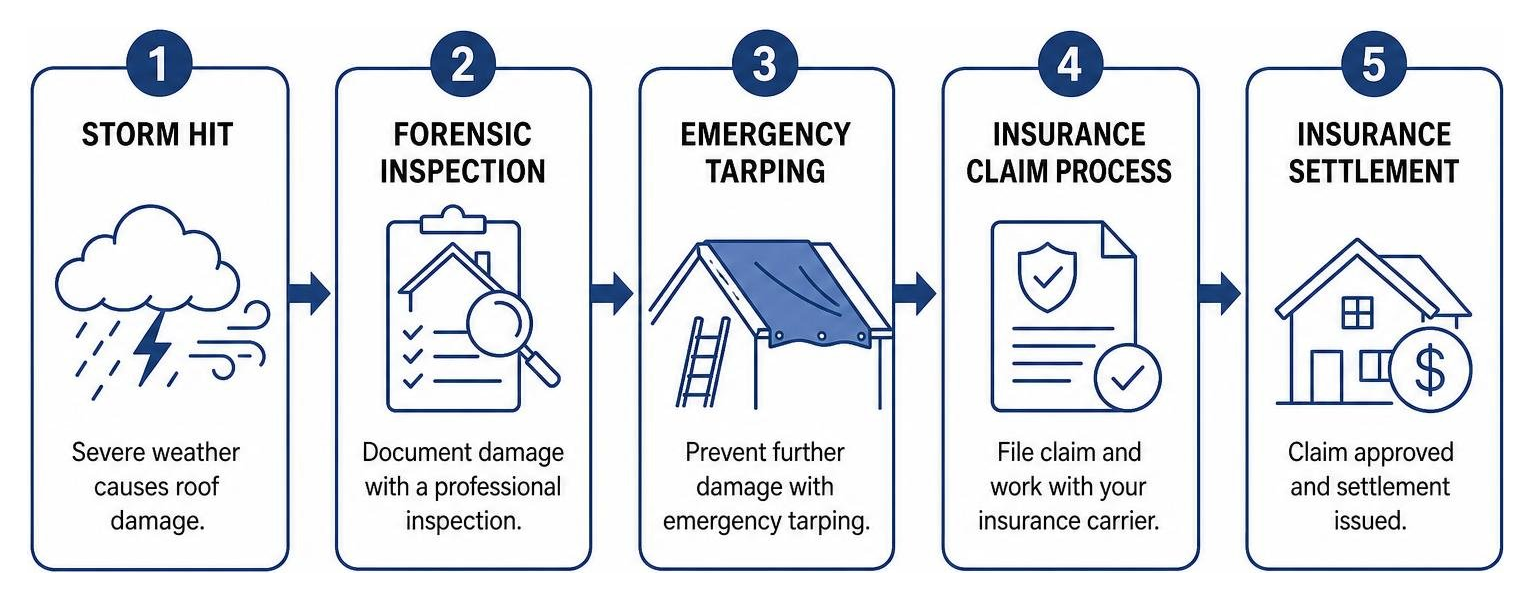
Follow these critical immediate steps following severe weather:
- Safety First: Never climb onto a wet, storm-damaged roof. Wet shingles lose traction, and compromised decking can collapse under foot traffic.
- Document Ground-Level Evidence: Take high-resolution photos and video of fallen branches, dented soft metals, outdoor furniture damage, and blown-off shingle tabs around your yard.
- Deploy Emergency Tarping: If active leaks occur, contract a licensed roofing professional to secure heavy-duty, weather-resistant tarps over vulnerable ridges, valleys, and roof punctures.
Prompt tarping stops secondary moisture penetration, prevents toxic mold growth in attic spaces, and proves to your insurer that you fulfilled your policy obligations. Learn more about protecting exposed structures by reviewing our professional emergency tarping protocols and consulting our helpful resource, Blog: Emergency Roof Repair Guide for Leaky Situations.
Professional Forensic Inspections for Storm Damage Roof Wesley Chapel Property Owners
Proving hidden storm impacts to an insurance adjuster requires scientific, verifiable evidence. Standard ground inspections miss microscopic fractures and subtle granule displacement. That is why specialized forensic roof assessments are essential for Wesley Chapel property owners.
A professional forensic inspection utilizes three advanced techniques:
- Soft Metal Logging: Roof inspectors perform close-range inspections of “soft metals” — including aluminum gutters, box vents, valley flashing, and metal ridge caps. Because aluminum deforms predictably under impact, logging pockmark density per square foot proves the severity and direction of a hailstorm to insurance adjusters.
- Infrared Moisture Mapping: Thermal imaging cameras detect hidden moisture trapped beneath single-ply commercial membranes or residential underlayment long before water stains appear on interior drywall.
- Macro-Photographic Documentation: High-magnification photography documents physical fractures in shingle fiberglass mats and bitumen displacement, leaving zero room for adjusters to claim damage is due to normal wear and tear.
To ensure your home is fully evaluated by local experts using high-definition forensic diagnostic tools, schedule an evaluation through our dedicated roof inspections team.
Florida Statutory Timelines and Supplemental Filing Limits
Time is your most critical legal asset following a severe storm event in Florida. State legislation has established strict, unyielding deadlines for filing insurance claims:
Under Florida Senate Statute 627.70132 Text, property owners have exactly one year from the date of the storm event (the “date of loss”) to formally file an initial property damage claim with their insurance carrier.
Furthermore, if additional hidden structural damage or hidden roof deck decay is uncovered during active repairs, property owners have up to 18 months from the original date of loss to file a supplemental claim. Missing these statutory deadlines permanently forfeits your right to recover insurance policy funds for storm restoration. For more details on navigating urgent insurance-covered restoration across Pasco County, read our guide, Blog: When the Levee Breaks Finding Fast Emergency Roof Repair in Florida, or contact our expert team for general roof repair support.
Frequently Asked Questions About Wesley Chapel Roof Storm Damage
How do I know if my roof has storm damage if it is not leaking yet?
Storm damage — especially hail impact — is rarely visible from the ground and seldom causes immediate interior ceiling leaks. Hailstones fracture the internal fiberglass mat of asphalt shingles and knock away protective surface granules without creating immediate holes. Over the next 6 to 12 months, Florida’s high heat and harsh UV rays bake the exposed asphalt layer, causing it to shrink, crack, and fail completely.
By the time water drips onto your ceiling, months of hidden moisture intrusion may have rotted your roof decking and trusses. The safest approach is to request a professional close-range roof inspection within days of any major Pasco County hailstorm or high-wind event.
How long do I have to file a storm damage roof claim in Florida?
Under Florida Statute 627.70132, property owners have one year from the official date of the weather event to file an initial property damage claim with their insurance company. If secondary structural damage or hidden water intrusion is uncovered during ongoing repairs, you have up to 18 months from the original date of loss to submit a supplemental claim. Because insurance companies require clear documentation linking the damage to a specific storm, scheduling an inspection immediately following an event ensures your claim remains legally valid.
What are soft metals and why do roofers inspect them after a storm?
“Soft metals” refer to soft aluminum and thin steel components on your roof, such as gutters, downspouts, metal roof vents (box vents), ridge vents, air conditioning fins, and chimney flashing. Because these soft metal components lack the elasticity of shingles, they dent easily upon impact. Roofers and insurance adjusters inspect soft metals first because dent pockmarks on gutters and vents serve as an unalterable physical timeline and verification record of hail size, impact density, and storm direction.
Conclusion
When Mother Nature unleashes high winds, severe hail, and tropical rain on Wesley Chapel, Land O’ Lakes, or Lutz, waiting to take action until water drips through your ceiling is a costly mistake. Hidden storm damage accelerates roof decay, threatens your family’s health with concealed mold growth, and risks exceeding Florida’s statutory one-year claim limit.
By understanding the mechanics of hail energy, leveraging the Florida 25% Rule and Matching Statute, and backing up your insurance claim with professional forensic photography and soft-metal impact logging, you protect your property investment and ensure your insurance carrier honors their contract.
At Thunder Bay Roofing, we live and work in the Wesley Chapel community. We bring years of Florida weather expertise, full state licensing and insurance, and customized storm damage restoration solutions directly to your doorstep. From immediate emergency tarping to comprehensive forensic claims documentation and code-compliant roof replacement, our team works tirelessly to restore your home’s protection.
Don’t let Florida’s brutal UV rays transform hidden storm impacts into expensive structural leaks. Protect your home today. Request your complimentary, comprehensive assessment online through our Free Roof Quote Assessment portal.