
The Ultimate Breakdown of Flat Roof Membrane Types and Systems
The Most Common Roofing Systems for Flat Roofs
Roofing systems for flat roofs are one of the most important decisions a property owner can make — and in Florida’s brutal climate, the stakes are even higher. Whether you own a home in Wesley Chapel or manage a commercial building across the Tampa Bay area, choosing the right flat roof system determines how well your property holds up against UV damage, heavy rain, and hurricane-force winds. As a leading provider of expert roofing services, we ensure your low-slope structure remains watertight and energy-efficient for decades.
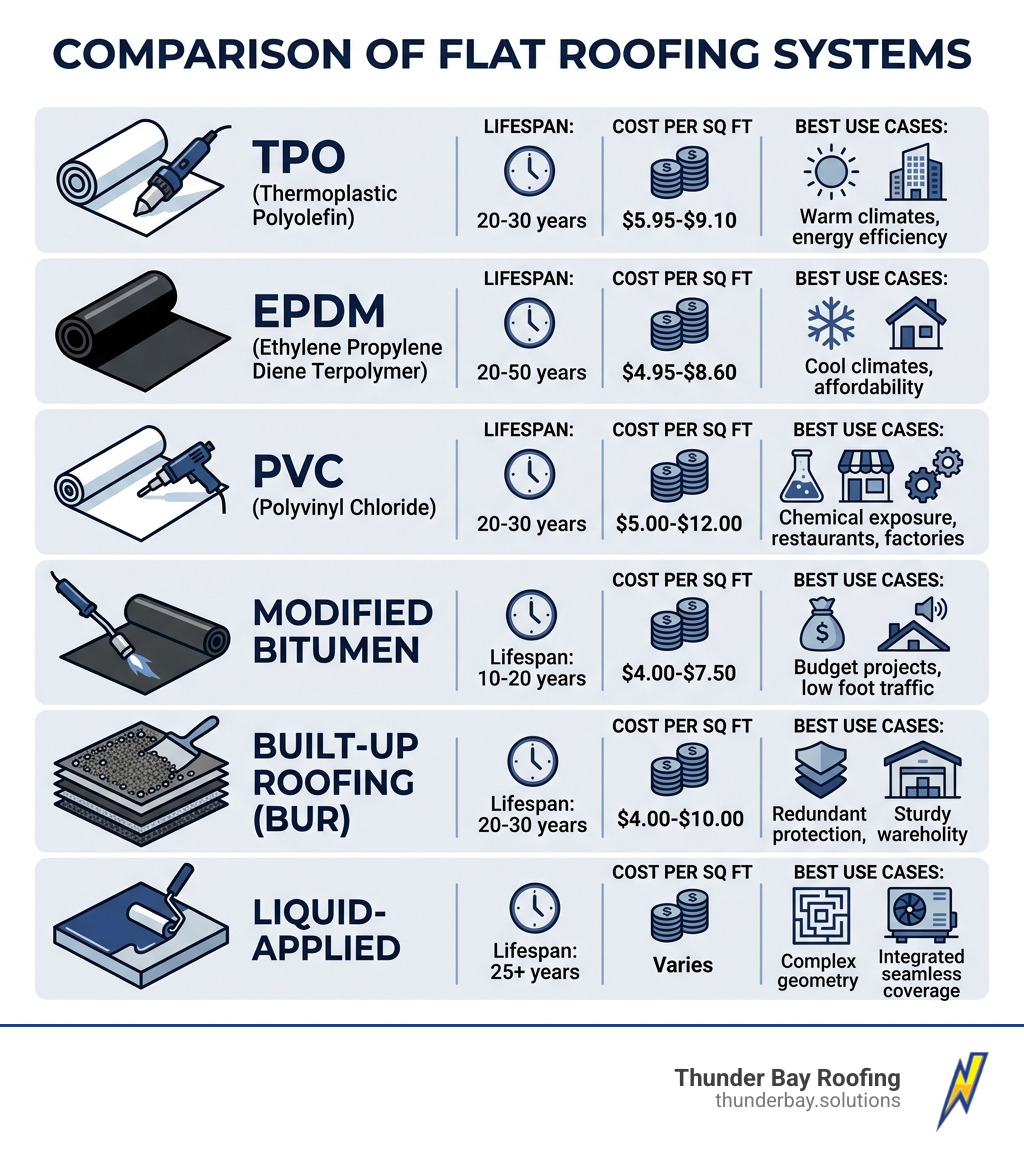
Here is a quick overview of the most common flat roofing systems available in 2026:
| System | Best For | Lifespan | Cost Per Sq Ft |
|---|---|---|---|
| TPO | Warm climates, energy efficiency | 20–30 years | $5.95–$9.10 |
| EPDM | Cool climates, affordability | 20–50 years | $4.95–$8.60 |
| PVC | Chemical exposure, restaurants, factories | 20–30 years | $5.00–$12.00 |
| Modified Bitumen | Budget projects, low foot traffic | 10–20 years | $4.00–$7.50 |
| Built-Up Roofing (BUR) | Redundant protection, high durability | 20–30 years | $4.00–$10.00 |
| Liquid-Applied | Complex geometry, seamless coverage | 25+ years | Varies |
| Green Roof | Urban buildings, stormwater management | 30–50 years | Varies |
Flat roofs — more accurately called low-slope roofs — are defined by a pitch of less than 3:12. Despite their reputation for leaks, modern flat roofing systems are highly engineered, long-lasting, and well-suited for both residential and commercial applications.
They are popular for good reason. Flat roofs offer a modern aesthetic, make efficient use of space, support rooftop equipment like HVAC units, and can even host solar panels or green roofs. As of May 2026, TPO holds roughly 40% of the new construction low-slope market, making it the single most installed flat roof membrane in North America. EPDM follows with a 22% share of new construction, according to data from CertainTeed.
But market share does not automatically mean the right fit for your building. Climate, budget, building use, and local code requirements all play a role — especially in Florida, where high-velocity hurricane zones (HVHZ) impose strict installation standards that not every system can meet.
I’m Tyler Wood, owner of Thunder Bay Home Solutions in Wesley Chapel, Florida, and through years of operating in one of the most demanding roofing environments in the country, I have worked hands-on with the full range of roofing systems for flat roofs — from TPO and EPDM to modified bitumen and liquid-applied membranes. In this guide, I’ll break down each system so you can make a confident, informed decision for your property.
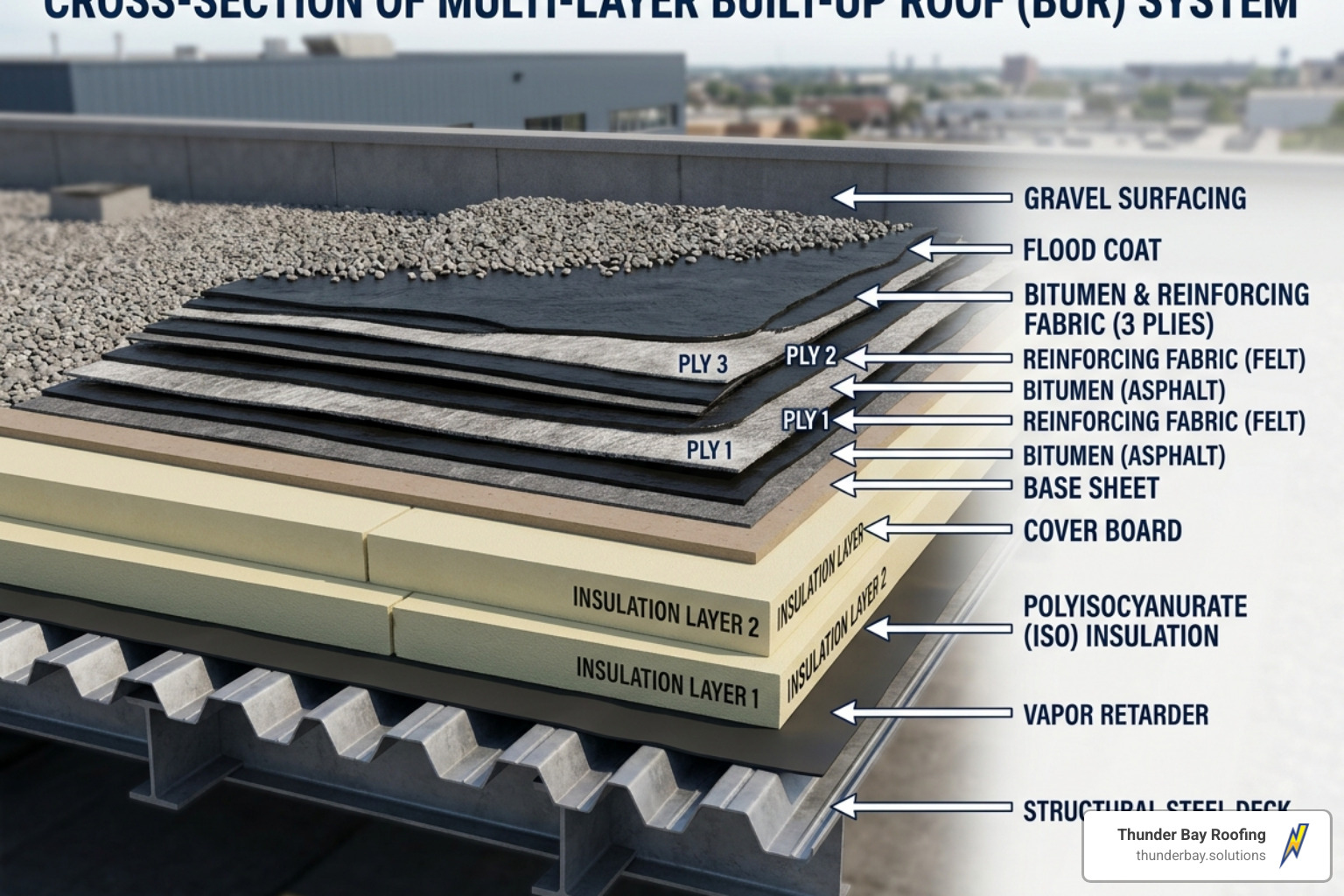
When we talk about expert roofing solutions, we aren’t just talking about a single product. A “system” includes the deck, vapor retarders, insulation, cover boards, and finally, the waterproofing membrane. Understanding the differences between these technologies is the first step toward a successful low slope roofing project.
Built-Up Roofing (BUR)
Often called the “grandfather” of flat roofs, Built-Up Roofing has been used for over 100 years. It consists of alternating layers of bitumen (asphalt or coal tar) and reinforcing fabrics (felts). The top layer is usually covered with gravel or a reflective coating.
- Pros: Highly redundant; if the top layer is punctured, the layers beneath stay watertight. It is excellent for high-traffic roofs.
- Cons: Extremely heavy and labor-intensive to install. The “hot mop” process involves hazardous fumes and open flames.
Modified Bitumen (Mod-Bit)
Developed in the 1960s as an evolution of BUR, Modified Bitumen uses asphalt that has been “modified” with polymers like SBS (styrene-butadiene-styrene) for rubber-like flexibility or APP (atactic polypropylene) for plastic-like durability. According to industry data, Mod-Bit holds about 12.4% of the new construction market.
- Pros: High tensile strength and easier to install than traditional BUR.
- Cons: Often requires torches for installation, which can be a fire risk for older wooden structures.
Single-Ply Membranes
These are the modern industry standard. They are factory-manufactured sheets of rubber or plastic that are rolled out and attached to the roof. Major manufacturers like Tremco UK and GAF offer high-performance versions of these membranes. They are categorized as either Thermosets (like EPDM) or Thermoplastics (like TPO and PVC).
Selecting the Right Roofing Systems for Flat Roofs
Choosing the right system isn’t just about the price tag. In Florida, we have to account for the “Big Three”: heat, humidity, and hurricanes.
- Climate Suitability: In Wesley Chapel and Lutz, roofs face intense UV radiation. A “cool roof” with high reflectivity is essential to keep cooling costs down.
- Chemical Resistance: If you are roofing a restaurant or a factory, grease and chemicals can dissolve certain materials like EPDM. In these cases, PVC is the superior choice.
- Reflectivity: White membranes like TPO reflect up to 80% of solar radiation, whereas black EPDM absorbs it. In Florida, white is almost always the way to go.
- Hurricane Readiness: If your roof is damaged during a storm, you need a contractor who understands hurricane damage roof repair. The attachment method (mechanical vs. adhered) determines whether your roof stays on the building during 120 mph winds.
Comparing Single-Ply Membranes: TPO, PVC, and EPDM
Single-ply membranes are the most popular roofing systems for flat roofs today because they are lightweight and relatively quick to install.
TPO (Thermoplastic Polyolefin)
TPO is currently the market leader. It is a blend of polypropylene and ethylene-propylene rubber. We frequently recommend TPO roofing for commercial clients in West Central Florida because of its balance between cost and performance.
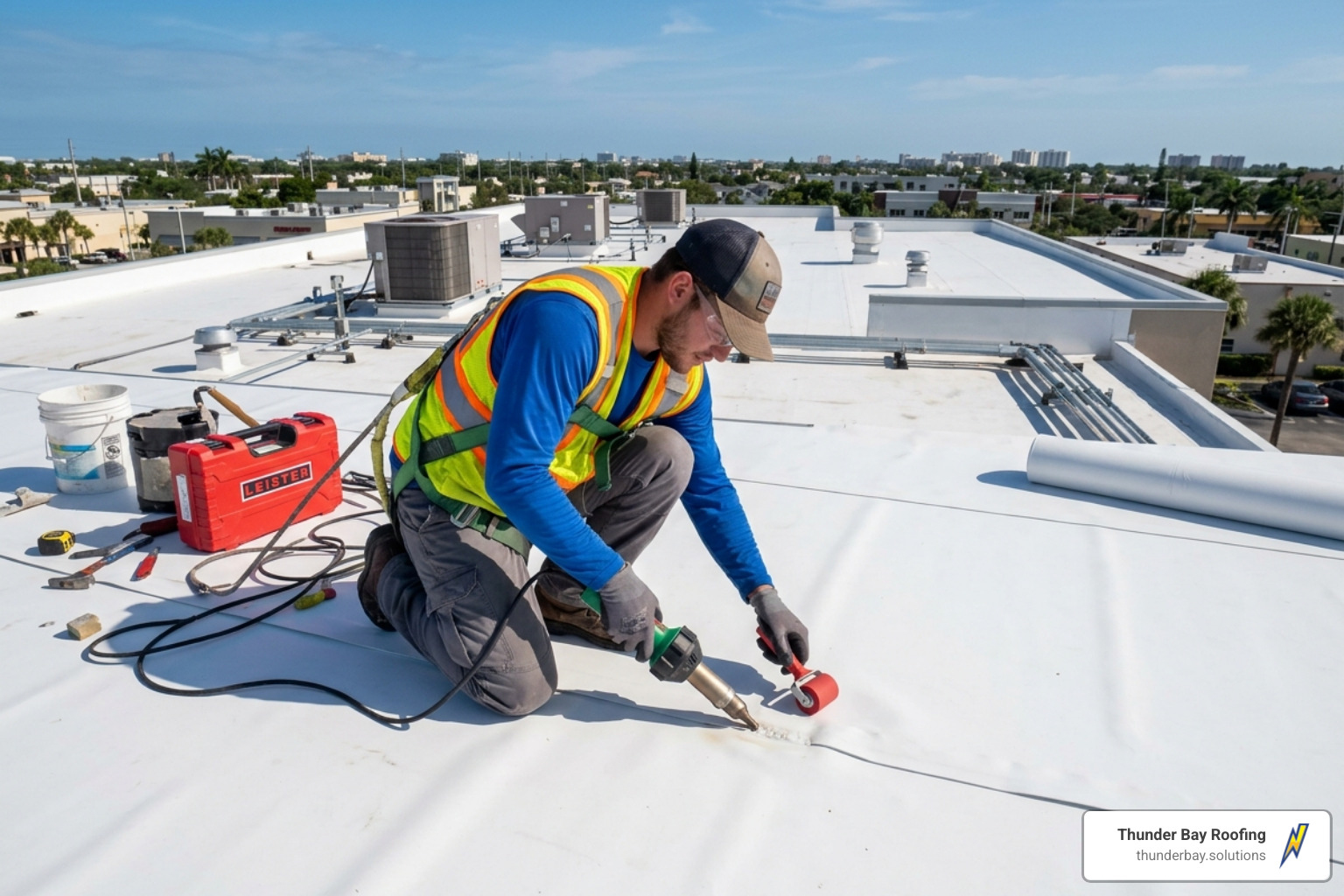
- Pros: Heat-welded seams are stronger than the membrane itself. Naturally fungal resistant and highly reflective.
- Cons: Because it is a newer technology, quality can vary significantly between manufacturers.
PVC (Polyvinyl Chloride)
PVC is the “premium” thermoplastic. It has been around longer than TPO and has a proven track record for durability.
- Pros: Exceptional resistance to chemicals, grease, and fire. It is more flexible than TPO, making it easier to install around complex vents and pipes.
- Cons: It is generally the most expensive single-ply option.
EPDM (Ethylene Propylene Diene Terpolymer)
EPDM is a synthetic rubber membrane. While it is incredibly durable—with some installations lasting up to 50 years—it is typically black.
- Pros: Very affordable and handles thermal shock (rapid temperature changes) extremely well.
- Cons: Adhered seams are a common failure point over time. In Florida, EPDM roofing can act like a giant heater for your building unless a white coating is applied.
Performance in High-Velocity Hurricane Zones
In Land O’ Lakes and Wesley Chapel, wind uplift is a major concern. For multi-family roofing or large commercial assets, we look at three primary attachment methods:
- Mechanically Fastened: The membrane is screwed into the roof deck. It’s fast but can allow the membrane to “flutter” in high winds.
- Fully Adhered: The membrane is glued to the substrate. This is the gold standard for wind resistance as it eliminates air gaps.
- Ballasted: The membrane is laid loose and held down by heavy river rocks. Warning: Ballasted roofs are generally prohibited in many Florida regions because the rocks can become flying missiles during a hurricane. If your roof has suffered wind damage, you should seek storm damaged roofing assistance immediately to prevent structural failure.
Traditional and Emerging Flat Roof Technologies
While membranes dominate the market, several other roofing systems for flat roofs are gaining traction in 2026.
Liquid-Applied Membranes
Liquid-applied systems, such as those from Sika, are becoming the “ultimate overlay solution.” These are cold-applied resins (often polyurethane or PMMA) that cure to form a seamless, rubber-like skin over the entire roof.
- Best Use Case: Roofs with complex geometry, hundreds of penetrations, or where “hot works” (torches) are prohibited by insurance.
- Advantages: They are “wet-on-wet” systems that are rainproof in as little as 30 minutes.
Metal Roofing
Wait, metal on a flat roof? While most metal roofs require a 2:12 pitch, standing seam metal is a highly durable option for low-slope applications. It can last 50 years or more. We specialize in commercial roofing and often suggest metal for clients looking for a “forever” roof.
Green and Blue Roofs
- Green Roofs: These involve a waterproofing layer topped with soil and vegetation. They are fantastic for reducing the urban heat-island effect and managing stormwater.
- Blue Roofs: Designed specifically to pond water temporarily during heavy Florida downpours, releasing it slowly into the drainage system to prevent flooding.
Sustainable and Energy-Efficient Options
In 2026, energy efficiency is no longer optional; it’s a requirement. Modern flat roof systems from IKO and GAF focus on “cool roof” technology. By using highly reflective surfaces, these systems can reduce a building’s cooling energy needs by up to 15%. If you are considering a commercial roof replacement, upgrading your insulation to Polyisocyanurate (Polyiso) at the same time can significantly increase your building’s R-value.
Lifespan, Maintenance, and Cost Analysis
One of the most frequent questions we get at Thunder Bay Home Solutions is: “How much is this going to cost me, and how long will it last?”
| Material | Average Cost (Installed) | Expected Lifespan |
|---|---|---|
| Modified Bitumen | $4.00 – $7.50 / sq ft | 10–20 Years |
| TPO | $5.95 – $9.10 / sq ft | 20–30 Years |
| EPDM | $4.95 – $8.60 / sq ft | 20–50 Years |
| PVC | $5.00 – $12.00 / sq ft | 20–30 Years |
| BUR | $4.00 – $10.00 / sq ft | 20–30 Years |
| Metal | $10.00 – $18.00 / sq ft | 40–50+ Years |
Note: These are national averages; local Florida labor rates and HVHZ requirements may impact final pricing. The average cost to replace a flat roof typically ranges between $4,000 and $19,000.
If your current roof is reaching the end of its life, a full roof replacement is often more cost-effective than constant repairs. In some cases, if the underlying structure is dry, we can perform a “roof recover” by adding a new membrane over the old one, saving you thousands in tear-off costs.
Protecting Your Investment with Regular Service
A flat roof is not “set it and forget it.” Because they lack natural drainage, they are prone to “ponding”—standing water that stays on the roof for more than 48 hours. This water can act as a magnifying glass for UV rays and put immense weight on the structure.
We recommend professional roof inspections at least twice a year. During these visits, we check for:
- Seam Integrity: Are the welds or tapes holding?
- Drainage Clearing: Are the scuppers and gutters free of debris?
- Biological Growth: Is moss or algae eating into the membrane?
- Punctures: Has a HVAC technician accidentally dropped a screw and stepped on it?
If you suspect a problem, our roof leak detection team uses infrared technology to find moisture trapped under the membrane before it rots your decking. Catching issues early allows for simple commercial roof repairs rather than a premature replacement.
Frequently Asked Questions about Roofing Systems for Flat Roofs
Which flat roof system is best for Florida’s climate?
For Florida, TPO and PVC are the top contenders. Their white, reflective surfaces combat the intense heat, and their heat-welded seams provide superior resistance to the heavy rain and wind uplift common in Wesley Chapel and Lutz.
How long do modern flat roofs last before replacement?
Most modern membranes like TPO, PVC, and EPDM will last 20 to 30 years if properly maintained. Some EPDM and metal systems can even reach the 50-year mark. However, Modified Bitumen typically has a shorter lifespan of 10 to 20 years.
What is the most cost-effective flat roofing material in 2026?
Modified Bitumen remains the most budget-friendly for initial installation. However, when you factor in energy savings from reflectivity and a longer lifespan, TPO often provides the best “total cost of ownership” over 25 years.
Conclusion
Navigating roofing systems for flat roofs can be overwhelming, but you don’t have to do it alone. At Thunder Bay Home Solutions, we pride ourselves on our Florida weather expertise and our commitment to providing customized, long-lasting solutions for our neighbors in Wesley Chapel, Land O’ Lakes, and Lutz.
Whether you need a minor repair, a detailed inspection, or a full system overhaul, we are licensed, insured, and ready to help. We don’t just “slap on a roof”—we install integrated systems designed to protect your assets for decades.
Ready to secure your property? Visit our Flat Roof Systems page to learn more about how we can help you stay dry and schedule your free inspection today.